What Are These Strange Mud Blobs on My Bird Feeder?
Sometimes the most fascinating discoveries aren't found deep in the woods—they're hanging right outside your back door.
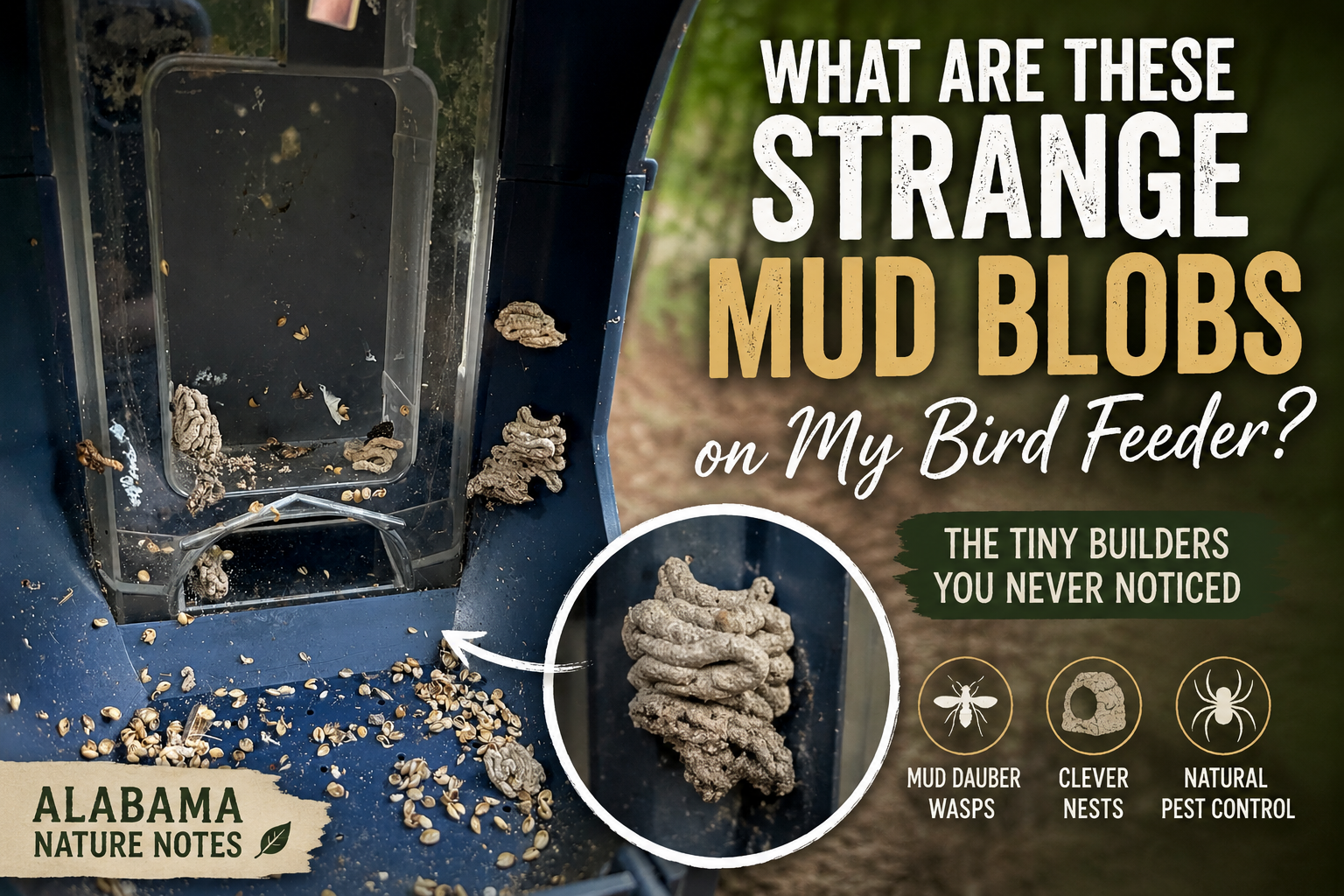
While walking out onto our deck recently, I noticed something unusual on an old bird feeder that hadn't been filled in quite some time. Attached to both the inside and outside of the feeder were several strange gray lumps that looked almost like tiny brains made of dried clay.
At first glance, I had no idea what they were.
My first thought was that they might be some kind of fungus or perhaps an insect egg mass. But a closer look revealed a rough, layered texture, almost as if someone had carefully stacked tiny ropes of mud on top of one another.
Nature had quietly been busy while I wasn't paying attention.
Tiny Master Builders
These curious structures are most likely the nests of solitary mud-building wasps, commonly known as mud daubers or one of their close relatives.
Unlike yellowjackets or hornets, these wasps don't live in large colonies. Each female works completely alone, acting as both architect and provider for her future offspring.
Using nothing more than tiny mouthfuls of wet mud collected from puddles or damp soil, she slowly builds one chamber at a time. Every trip adds another thin layer until a nursery is complete.
It's remarkable to think that each of these little nests was built pellet by pellet by an insect only about an inch long.
Why My Bird Feeder?
From a wasp's perspective, an empty bird feeder is prime real estate.
It's sheltered from rain.
It's protected from harsh sunlight.
It's attached to a solid surface.
And since the feeder hadn't been used for a while, it probably wasn't disturbed very often.
To us, it's an old feeder.
To a solitary wasp, it's the perfect place to raise a family.
A Nursery... Not a Home
Although they look like miniature apartments, these mud structures aren't permanent homes.
Each chamber serves a single purpose.
After building the cell, the female hunts for spiders or, depending on the species, small caterpillars. She stings them, which paralyzes—but usually doesn't kill—them.
She then places several of these motionless meals inside the chamber before laying a single egg.
Finally, she seals the entrance with more mud and flies away.
When the egg hatches, the developing larva has a fresh food supply waiting for it. Once it has grown large enough, it forms a cocoon, transforms into an adult wasp, and eventually chews its way out, leaving behind a neat little exit hole.
Nature's Pest Control
While many people become nervous whenever they hear the word "wasp," solitary mud wasps are among the gentlest wasps you'll find in Alabama.
They rarely sting people because they have no colony to defend.
Instead, they spend their days hunting spiders and other small creatures that many homeowners would rather not have around.
In other words, these tiny builders are quietly helping keep backyard ecosystems in balance.
Looking a Little Closer
The nests on our feeder vary in size, with some consisting of just a single chamber while others are clustered together in irregular groups.
Their wrinkled appearance makes them look almost sculpted by hand.
I have no idea how long they've been there. It's entirely possible they were built while I was busy watching our Carolina Wrens raise their family just a few feet away.
It's amazing how much wildlife shares our yards without us ever noticing.
Nature Never Stops Surprising Me
One of the things I love most about spending time outdoors is discovering something new that I had walked past dozens of times before.
An abandoned bird feeder became home to a completely different creature.
What first looked like strange blobs of dried mud turned out to be carefully constructed nurseries built by one of Alabama's most overlooked insects.
It makes me wonder...
How many other tiny stories are unfolding around us every day without us even realizing they're there?
Maybe all it takes is slowing down long enough to notice.
Have you ever found mud nests attached to your porch, shed, mailbox, or bird feeder? I'd love to hear about your discoveries in the comments!