
Where Did the Baby Wrens Go After Leaving the Nest?
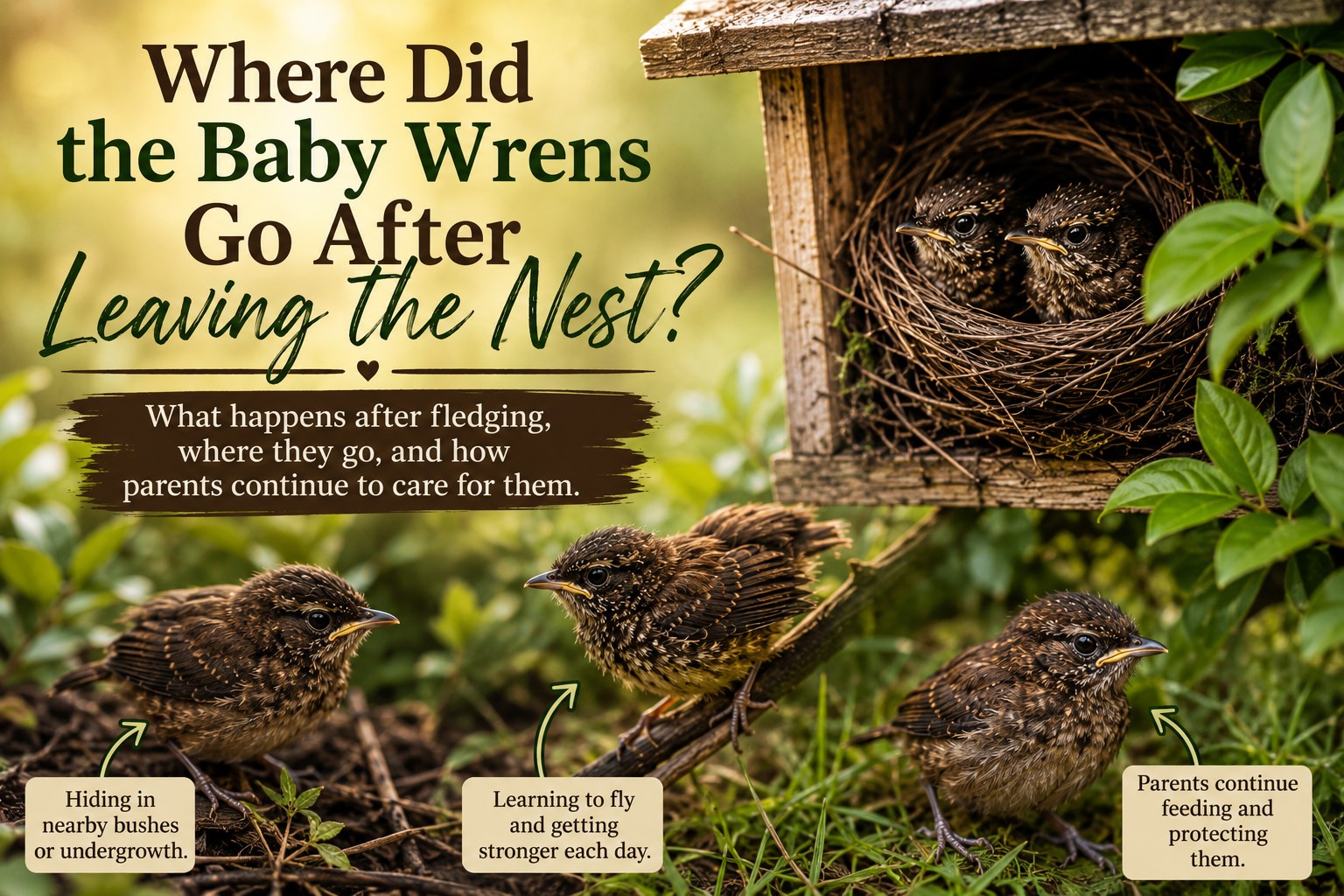
For weeks, our little Carolina Wren family had become part of our everyday lives.
Each morning we'd quietly check on the nest, watching four hungry chicks grow bigger, louder, and more adventurous. Then one day, almost without warning...
The nest was empty.
At first, we couldn't help but wonder what had happened. Had something gone wrong? Were they safe? Would they come back?
As it turns out, an empty nest is often one of the best signs you can hope for.
Baby Wrens Don't Stay in the Nest for Long
Carolina Wren chicks grow remarkably fast.
After hatching, they spend around 12 to 16 days developing inside the nest. During this time, both parents work tirelessly bringing insects to feed their growing family.
By the time they leave, the chicks already have most of their feathers, although they're still far from being expert flyers.
When they're ready, they don't simply fly away like adult birds.
Instead, they fledge.
What Is Fledging?
Fledging is the stage when young birds leave the nest before they've completely mastered flying.
It's a perfectly normal—and very important—part of growing up.
Many people expect young birds to soar confidently into the sky the moment they leave the nest.
The reality is much different.
Baby wrens often flutter awkwardly to the ground, hop between branches, hide under bushes, or cling to low vegetation while they build strength and confidence.
It can look alarming if you've never seen it before.
Where Do They Go?
Once the babies leave the nest, they usually don't travel very far.
In fact, they're often hiding only a few yards away.
They naturally seek dense shrubs, thick bushes, low tree branches, brush piles, or other sheltered areas where predators are less likely to find them.
Because they're so well camouflaged, you can easily walk right past a fledgling without ever realizing it's there.
The Parents Haven't Abandoned Them
One of the biggest surprises for us was learning that leaving the nest doesn't mean the babies are suddenly on their own.
Far from it.
Both parent wrens continue feeding and protecting their young for another week or two after fledging.
During this time, the parents know exactly where each youngster is hiding and visit them regularly with insects throughout the day.
Even if you never see the fledglings again, the parents almost certainly do.
Our Own Carolina Wren Family
When our four little wrens finally left their nest, the silence felt almost strange.
After weeks of constant chirping and watching the parents arrive every few minutes with food, it was hard to believe the nest could suddenly be empty.
For much of that day we could still hear Birdie and her mate calling nearby.
At first, we wondered whether they were searching for the babies.
Later, we learned those calls were likely part of normal communication between the parents and their newly fledged youngsters hidden somewhere nearby.
Although we never saw all four babies together again, it was comforting to know that their story hadn't ended—it had simply moved beyond the nest.
Should You Help a Baby Wren?
Usually...
No.
If a young bird is fully feathered, alert, hopping around, and doesn't appear injured, it's almost certainly a fledgling.
This is exactly where it's supposed to be.
Although it may look vulnerable, its parents are usually close by and continuing to care for it.
The best thing you can do is:
- Keep cats indoors if possible.
- Keep dogs away from the immediate area for a short time.
- Observe from a distance.
- Resist the urge to move or rescue the bird unless it's clearly injured or in immediate danger.
Nature often knows what it's doing.
Will They Return to the Nest?
One question we asked ourselves was whether we'd see the babies return that evening.
The answer is no.
Once Carolina Wrens leave the nest, they generally don't move back in.
Instead, they spend their nights hidden in thick vegetation while continuing to follow their parents as they learn to find food and avoid predators.
The nest has served its purpose.
Now it's time for the next chapter.
Looking Back
Watching our Carolina Wren family from the very first twig to the day the babies left the nest has been one of the most rewarding wildlife experiences we've ever had.
It reminded us that sometimes the most exciting parts of nature happen just out of sight.
The nest may be empty now, but somewhere nearby, four young wrens are learning how to become independent birds.
And that's exactly how the story is supposed to end.
Or perhaps...
How the next chapter begins.
Videos documenting this entire journey will be available through YouTube shortly.