
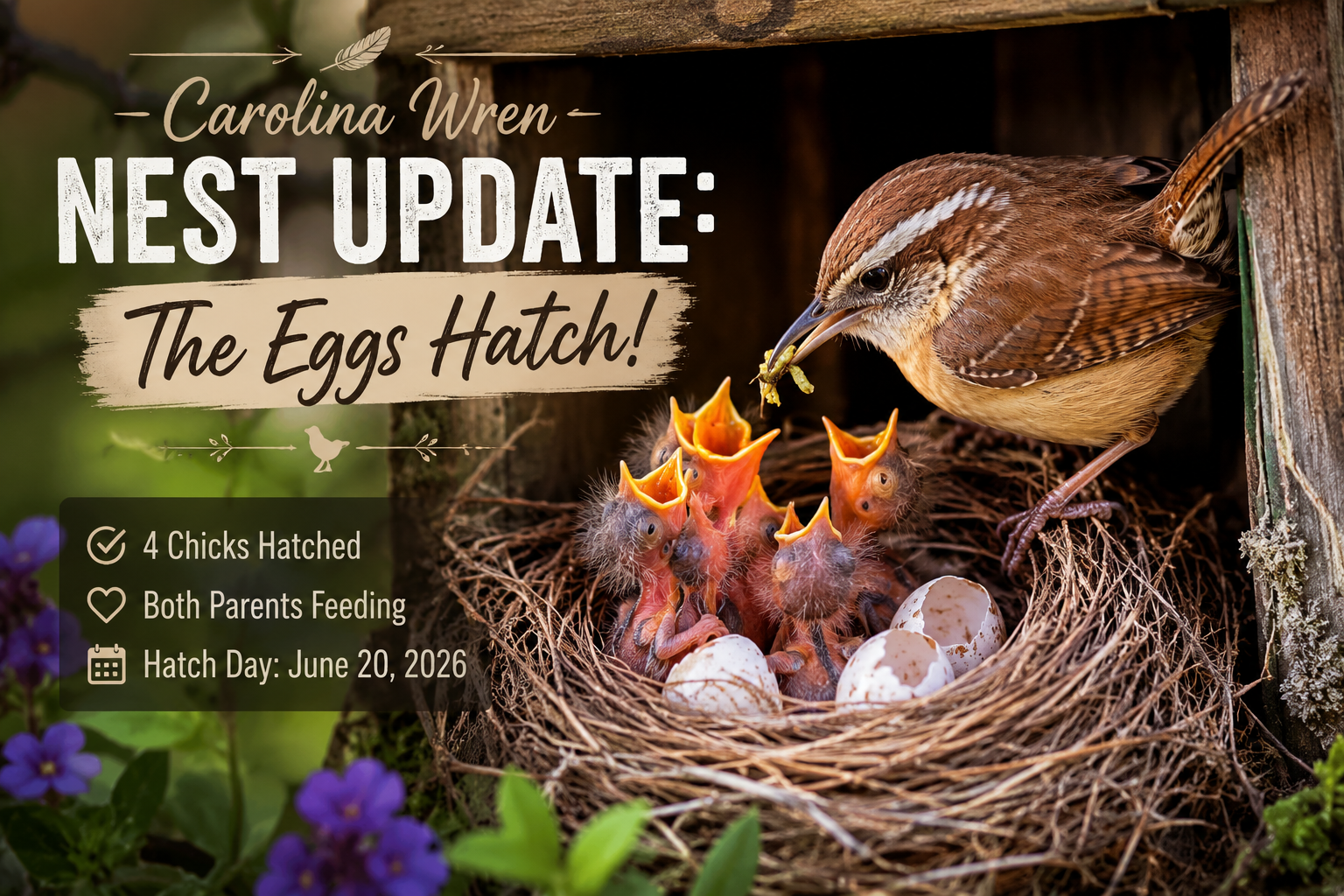
Carolina Wren Nest Update: The Eggs Hatch!
Last Updated: June 21, 2026
Current Nest Status
- Nest Active
- 4 Chicks Hatched
- Both Parents Feeding
- Nestlings Growing Rapidly
- Hatch Day: June 20, 2026
A Long Week of Waiting
Following the unusual events of June 13, when Birdie removed and consumed one of the eggs, incubation continued much as it had for the previous week.
Each morning began shortly after sunrise when Birdie would leave the nest for her first feeding trip of the day. She would typically return within 20 to 60 minutes before settling back onto the remaining eggs.
By this point, incubation had become a carefully coordinated effort between Birdie and her companion.
While Birdie spent most of her time on the nest, the male Carolina Wren was becoming increasingly attentive. He visited multiple times throughout the day, frequently arriving shortly after Birdie returned from her feeding trips.
Several visits involved him bringing food directly to Birdie while she remained on the nest.
One particularly amusing moment occurred on June 16 when the companion arrived carrying a twig. Birdie appeared completely uninterested in his gift, so he added it to the nest himself before flying away.
Even after more than a week of incubation, both birds still occasionally brought fresh nesting materials to the nest, suggesting that maintenance and reinforcement are ongoing parts of the nesting process.
The Final Days Before Hatching
Between June 15 and June 19, Birdie remained remarkably dedicated to the nest.
Temperatures were increasing, and on June 19 she was observed appearing noticeably warm and tired while continuing her incubation duties.
Despite the long hours, she rarely spent extended periods away from the eggs.
The companion continued to patrol the nesting area and deliver food to Birdie throughout the day.
At this point, all signs suggested hatch day was approaching.
Hatch Day Arrives
On June 20, after nearly two weeks of incubation, the first signs of hatching finally appeared.
Earlier in the day, four eggs were still visible inside the nest.
By late afternoon, everything changed.
At approximately 4:00 PM, two chicks had successfully hatched while two eggs remained intact.
Within minutes, Birdie was already feeding the newly hatched nestlings.
The pace of activity increased dramatically as both parents began making frequent trips to gather food.
Shortly afterward, a third chick emerged.
Birdie was observed removing and consuming pieces of eggshell, a completely normal behavior that helps recycle nutrients while keeping the nest clean and reducing evidence that could attract predators.
Throughout the afternoon and evening, both parents worked almost nonstop.
The companion repeatedly delivered food to Birdie while she remained near the nest caring for the hatchlings.
Around 7:30 PM, the fourth and final chick hatched.
Birdie quickly removed the last eggshell fragments and carried them away from the nest site.
For the first time since the eggs were laid, the nest contained four healthy Carolina Wren chicks instead of eggs.
A Completely Different Routine
The morning of June 21 looked nothing like the previous weeks.
During incubation, Birdie might leave the nest every hour or two.
Now she was making feeding trips every few minutes.
From shortly after sunrise, both parents were constantly arriving with insects and other food items for the hungry chicks.
In many cases, Birdie would return with food, feed the nestlings, and leave again almost immediately.
The companion was equally busy.
He frequently arrived carrying food and often fed either Birdie or the chicks directly before departing to gather more.
The amount of work required to raise four growing nestlings became obvious within just the first few hours after hatching.
The nest that had spent nearly two weeks in relative quiet suddenly became a hub of nonstop activity.
Looking Ahead
The next stage of the journey may be the most exciting yet.
Over the coming days the chicks should grow rapidly, develop feathers, open their eyes, and become increasingly active inside the nest.
Both parents now face the demanding task of keeping four hungry mouths fed from dawn until dusk.
We'll continue documenting their progress as the nestlings grow and move closer to their eventual fledging day.
Stay tuned for more updates from Birdie, her devoted companion, and their growing family.