<?xml version="1.0" encoding="utf-8"?>
<feed xmlns="http://www.w3.org/2005/Atom" xmlns:media="http://search.yahoo.com/mrss/">
    <title>Alabama Nature Notes</title>
    <link href="https://alabamanaturenotes.com/feed.xml" rel="self" />
    <link href="https://alabamanaturenotes.com" />
    <updated>2026-07-07T19:58:39-05:00</updated>
    <author>
        <name>Rachy</name>
    </author>
    <id>https://alabamanaturenotes.com</id>

    <entry>
        <title>Banded Tussock Moth Caterpillar in Alabama: A Tiny Ball of Yellow Fuzz</title>
        <author>
            <name>Rachy</name>
        </author>
        <link href="https://alabamanaturenotes.com/banded-tussock-moth-caterpillar-alabama/"/>
        <id>https://alabamanaturenotes.com/banded-tussock-moth-caterpillar-alabama/</id>
        <media:content url="https://alabamanaturenotes.com/media/posts/23/bandedmoth.png" medium="image" />
            <category term="wildlife photography"/>
            <category term="native insects"/>
            <category term="backyard wildlife"/>
            <category term="Yellow Caterpillar"/>
            <category term="Tiger Moths"/>
            <category term="Summer Wildlife"/>
            <category term="Northeast Alabama"/>
            <category term="Nature Photography"/>
            <category term="Moths"/>
            <category term="Halysidota tessellaris"/>
            <category term="Fuzzy Caterpillar"/>
            <category term="Caterpillars"/>
            <category term="Banded Tussock Moth Caterpillar"/>
            <category term="Banded Tussock Moth"/>
            <category term="Alabama nature"/>
            <category term="Alabama Wildlife"/>
            <category term="Alabama Nature Notes"/>
            <category term="Alabama Insects"/>

        <updated>2026-07-07T19:58:39-05:00</updated>
            <summary type="html">
                <![CDATA[
                        <img src="https://alabamanaturenotes.com/media/posts/23/bandedmoth.png" alt="" />
                    Sometimes the most fascinating wildlife isn't the largest animal in the woods—it's&hellip;
                ]]>
            </summary>
        <content type="html">
            <![CDATA[
                    <p><img src="https://alabamanaturenotes.com/media/posts/23/bandedmoth.png" class="type:primaryImage" alt="" /></p>
                <p class="PDq2pG_selectionAnchorContainer" data-start="224" data-end="359">Sometimes the most fascinating wildlife isn't the largest animal in the woods—it's the tiny creatures that most people walk right past.</p>
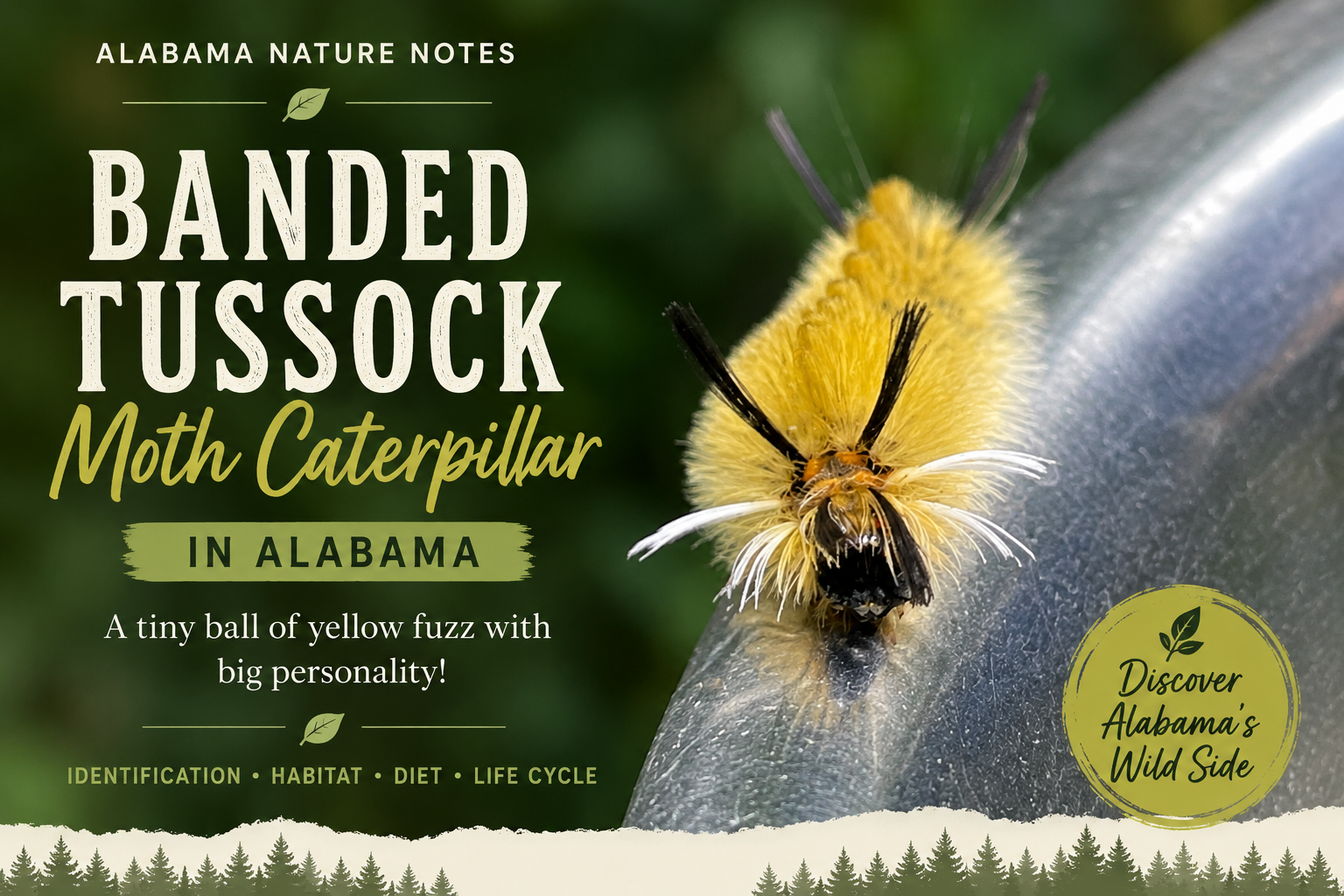
<p data-start="361" data-end="681">While spending time outdoors here in northeast Alabama, I spotted what looked like a little tuft of bright yellow fur resting quietly on a metal water bowl. As I moved in for a closer look, I realized it was one of Alabama's most eye-catching caterpillars—the <strong data-start="618" data-end="653">Banded Tussock Moth caterpillar</strong> (<em data-start="655" data-end="679">Halysidota tessellaris</em>).</p>
<p data-start="683" data-end="833">With its fluffy coat and dramatic black tufts, it's easy to see why this little insect catches the attention of photographers and nature lovers alike.</p>
<h2 data-section-id="18z3o4y" data-start="835" data-end="860">Nature's Tiny Fuzzball</h2>
<p data-start="862" data-end="982">The Banded Tussock Moth caterpillar is covered in soft-looking yellow hairs, giving it the appearance of a tiny pom-pom.</p>
<p data-start="984" data-end="1284">One of its most distinctive features is the pair of long black "hair pencils" that extend upward near the front of its body. Additional black tufts along its back and long white hairs around the sides give it an almost comical appearance, making it one of the easiest fuzzy caterpillars to recognize.</p>
<p data-start="1286" data-end="1384">Although it looks soft enough to pick up, it's much better appreciated from a respectful distance.</p>
<h2 data-section-id="g0poig" data-start="1386" data-end="1407">Please Don't Touch</h2>
<p data-start="1409" data-end="1588">Like many fuzzy caterpillars, the hairs of the Banded Tussock Moth can cause skin irritation in some people. Most reactions are mild, but sensitivity varies from person to person.</p>
<p data-start="1590" data-end="1744">If you happen to find one during a walk or in your own backyard, the best approach is to admire it, snap a few photos, and let it continue on its journey.</p>
<h2 data-section-id="1vjszz4" data-start="1746" data-end="1766">What Does It Eat?</h2>
<p data-start="1768" data-end="1898">These caterpillars aren't picky eaters. They feed on the leaves of many common hardwood trees found throughout Alabama, including:</p>
<ul data-start="1900" data-end="1952">
<li data-section-id="1o4b2l" data-start="1900" data-end="1905">Oak</li>
<li data-section-id="16vtl0d" data-start="1906" data-end="1913">Maple</li>
<li data-section-id="o0pi5h" data-start="1914" data-end="1923">Hickory</li>
<li data-section-id="1o4j8s" data-start="1924" data-end="1929">Elm</li>
<li data-section-id="16xxk8q" data-start="1930" data-end="1937">Birch</li>
<li data-section-id="1o4gk2" data-start="1938" data-end="1943">Ash</li>
<li data-section-id="8patvy" data-start="1944" data-end="1952">Willow</li>
</ul>
<p data-start="1954" data-end="2075">Because they use such a wide variety of host trees, they can be found in forests, parks, and even suburban neighborhoods.</p>
<h2 data-section-id="bmgq12" data-start="2077" data-end="2120">From Fuzzy Caterpillar to Beautiful Moth</h2>
<p data-start="2122" data-end="2238">After several weeks of feeding, the caterpillar spins a cocoon where it transforms into the <strong data-start="2214" data-end="2237">Banded Tussock Moth</strong>.</p>
<p data-start="2240" data-end="2489">The adult moth looks completely different from its colorful caterpillar stage. Instead of bright yellow fuzz, it wears soft shades of tan, cream, and light brown with delicate wavy markings that help it blend perfectly into tree bark during the day.</p>
<p data-start="2491" data-end="2588">It's an amazing transformation—and one of the many reasons insects are so fascinating to observe.</p>
<h2 data-section-id="1otkv8k" data-start="2590" data-end="2616">A Reminder to Slow Down</h2>
<p data-start="2618" data-end="2723">One of my favorite things about nature photography is discovering unexpected wildlife in ordinary places.</p>
<p data-start="2725" data-end="2899">This tiny caterpillar may only be a couple of inches long, but its brilliant yellow coloring and unique hairstyle make it one of the most memorable insects I've photographed.</p>
<p data-start="2901" data-end="3140">Moments like this remind me that Alabama's natural world is full of incredible surprises. Whether you're exploring a hiking trail or simply stepping outside into your backyard, there's always something interesting waiting to be discovered.Id</p>
<h2 class="PDq2pG_selectionAnchorContainer" data-section-id="xcqxqb" data-start="3270" data-end="3284">Quick Facts</h2>
<p data-start="3286" data-end="3334"><strong data-start="3286" data-end="3302">Common Name:</strong> Banded Tussock Moth Caterpillar</p>
<p data-start="3336" data-end="3381"><strong data-start="3336" data-end="3356">Scientific Name:</strong> <em data-start="3357" data-end="3381">Halysidota tessellaris</em></p>
<p data-start="3383" data-end="3417"><strong data-start="3383" data-end="3394">Family:</strong> Erebidae (Tiger Moths)</p>
<p data-start="3419" data-end="3485"><strong data-start="3419" data-end="3432">Found In:</strong> Much of the eastern United States, including Alabama</p>
<p data-start="3487" data-end="3523"><strong data-start="3487" data-end="3496">Size:</strong> Up to 2 inches (5 cm) long</p>
<p data-start="3525" data-end="3619"><strong data-start="3525" data-end="3534">Diet:</strong> Leaves of deciduous trees including oak, maple, elm, hickory, birch, ash, and willow</p>
<p data-start="3621" data-end="3710"><strong data-start="3621" data-end="3633">Defense:</strong> Hair-covered body helps discourage predators and may irritate sensitive skin</p>
<p data-start="3712" data-end="3751"><strong data-start="3712" data-end="3727">Adult Form:</strong> The Banded Tussock Moth</p>
<p data-start="3753" data-end="3836"><strong data-start="3753" data-end="3769">Best Advice:</strong> Enjoy with your eyes and camera—avoid handling fuzzy caterpillars.</p>
            ]]>
        </content>
    </entry>
    <entry>
        <title>A Peaceful Encounter with an Alabama White-Tailed Deer</title>
        <author>
            <name>Rachy</name>
        </author>
        <link href="https://alabamanaturenotes.com/peaceful-encounter-alabama-white-tailed-deer/"/>
        <id>https://alabamanaturenotes.com/peaceful-encounter-alabama-white-tailed-deer/</id>
        <media:content url="https://alabamanaturenotes.com/media/posts/22/deer.png" medium="image" />
            <category term="Wildlife Watching"/>
            <category term="White-tailed Deer"/>
            <category term="Summer in Alabama"/>
            <category term="Nature Photography"/>
            <category term="Native Wildlife"/>
            <category term="Mammals"/>
            <category term="Forest Animals"/>
            <category term="Alabama nature"/>
            <category term="Alabama Wildlife"/>
            <category term="Alabama Nature Notes"/>

        <updated>2026-07-07T19:36:38-05:00</updated>
            <summary type="html">
                <![CDATA[
                        <img src="https://alabamanaturenotes.com/media/posts/22/deer.png" alt="" />
                    One of the joys of living in Alabama is never knowing what&hellip;
                ]]>
            </summary>
        <content type="html">
            <![CDATA[
                    <p><img src="https://alabamanaturenotes.com/media/posts/22/deer.png" class="type:primaryImage" alt="" /></p>
                <p class="PDq2pG_selectionAnchorContainer" data-start="184" data-end="452">One of the joys of living in Alabama is never knowing what wildlife might appear around the next corner. Today, we were treated to a quiet visit from one of our state's most graceful residents—a beautiful white-tailed deer standing peacefully at the edge of the woods.</p>
<p data-start="454" data-end="745">She paused among the tall summer greenery, ears perked forward, carefully listening to the sounds around her. Although she seemed aware of our presence, she wasn't alarmed. After a few quiet moments, she continued on her way, disappearing back into the forest as quietly as she had appeared.</p>
<h2 data-section-id="1dm92rq" data-start="747" data-end="787">Alabama's Most Familiar Wild Neighbor</h2>
<p data-start="789" data-end="1005">The White-tailed Deer (<em data-start="812" data-end="836">Odocoileus virginianus</em>) is the most common deer species found throughout Alabama. They thrive in forests, fields, farmland, and even suburban neighborhoods where food and cover are plentiful.</p>
<p data-start="1007" data-end="1223">The edge of the woods—where forests meet open areas—is one of their favorite places to spend time. These "edge habitats" provide easy access to both nutritious plants and the safety of nearby trees if danger appears.</p>
<h2 data-section-id="1erdulk" data-start="1225" data-end="1246">Built for Survival</h2>
<p data-start="1248" data-end="1334">White-tailed deer have some incredible adaptations that help them survive in the wild.</p>
<p data-start="1336" data-end="1679">Their large ears can rotate independently, allowing them to detect sounds coming from almost any direction. Their sense of smell is exceptionally powerful, helping them recognize predators long before they are seen. While their eyesight isn't as sharp as ours when it comes to detail, they are experts at detecting even the slightest movement.</p>
<p data-start="1681" data-end="1818">If startled, a white-tailed deer can sprint up to 30 miles per hour, leap nearly 8 feet high, and cover almost 30 feet in a single bound.</p>
<h2 data-section-id="o6gw24" data-start="1820" data-end="1836">A Summer Coat</h2>
<p data-start="1838" data-end="2054">This deer is wearing her reddish-brown summer coat, which is much lighter and thinner than the grayish coat she'll grow later in the year. The lighter coat helps deer stay cool during Alabama's hot and humid summers.</p>
<p data-start="2056" data-end="2233">During this time of year, deer spend much of their day feeding on tender leaves, grasses, wildflowers, vines, and berries while raising their young in the shelter of the forest.</p>
<h2 data-section-id="1c8qzi1" data-start="2235" data-end="2261">Nature Rewards Patience</h2>
<p data-start="2263" data-end="2475">Wildlife encounters like this are a wonderful reminder that some of nature's best moments can't be planned. Sometimes all it takes is slowing down, looking toward the tree line, and being quiet for a few minutes.</p>
<p data-start="2477" data-end="2586">The forests of Alabama are full of life, and every walk outdoors offers the chance to discover something new.</p>
            ]]>
        </content>
    </entry>
    <entry>
        <title>Where Did the Baby Wrens Go After Leaving the Nest?</title>
        <author>
            <name>Rachy</name>
        </author>
        <link href="https://alabamanaturenotes.com/where-did-the-baby-wrens-go-after-leaving-the-nest/"/>
        <id>https://alabamanaturenotes.com/where-did-the-baby-wrens-go-after-leaving-the-nest/</id>
        <media:content url="https://alabamanaturenotes.com/media/posts/21/afterthenest.png" medium="image" />
            <category term="Wildlife Education"/>
            <category term="Wildlife"/>
            <category term="Nature Journal"/>
            <category term="Fledging Birds"/>
            <category term="Carolina Wren Nest"/>
            <category term="Carolina Wren"/>
            <category term="Bird Watching"/>
            <category term="Bird Behavior"/>
            <category term="Backyard Birds"/>
            <category term="Baby Birds"/>
            <category term="Alabama Wildlife"/>
            <category term="Alabama Nature Notes"/>

        <updated>2026-07-03T21:57:22-05:00</updated>
            <summary type="html">
                <![CDATA[
                        <img src="https://alabamanaturenotes.com/media/posts/21/afterthenest.png" alt="" />
                    For weeks, our little Carolina Wren family had become part of our&hellip;
                ]]>
            </summary>
        <content type="html">
            <![CDATA[
                    <p><img src="https://alabamanaturenotes.com/media/posts/21/afterthenest.png" class="type:primaryImage" alt="" /></p>
                <p class="PDq2pG_selectionAnchorContainer" data-start="449" data-end="530">For weeks, our little Carolina Wren family had become part of our everyday lives.</p>
<p data-start="532" data-end="687">Each morning we'd quietly check on the nest, watching four hungry chicks grow bigger, louder, and more adventurous. Then one day, almost without warning...</p>
<p data-start="689" data-end="708">The nest was empty.</p>
<p data-start="710" data-end="830">At first, we couldn't help but wonder what had happened. Had something gone wrong? Were they safe? Would they come back?</p>
<p data-start="832" data-end="911">As it turns out, an empty nest is often one of the best signs you can hope for.</p>
<h2 data-section-id="rcuxqi" data-start="913" data-end="958">Baby Wrens Don't Stay in the Nest for Long</h2>
<p data-start="960" data-end="1002">Carolina Wren chicks grow remarkably fast.</p>
<p data-start="1004" data-end="1177">After hatching, they spend around <strong data-start="1038" data-end="1055">12 to 16 days</strong> developing inside the nest. During this time, both parents work tirelessly bringing insects to feed their growing family.</p>
<p data-start="1179" data-end="1303">By the time they leave, the chicks already have most of their feathers, although they're still far from being expert flyers.</p>
<p data-start="1305" data-end="1369">When they're ready, they don't simply fly away like adult birds.</p>
<p data-start="1371" data-end="1396">Instead, they <strong data-start="1385" data-end="1395">fledge</strong>.</p>
<h2 data-section-id="p515eu" data-start="1398" data-end="1418">What Is Fledging?</h2>
<p data-start="1420" data-end="1516">Fledging is the stage when young birds leave the nest before they've completely mastered flying.</p>
<p data-start="1518" data-end="1580">It's a perfectly normal—and very important—part of growing up.</p>
<p data-start="1582" data-end="1677">Many people expect young birds to soar confidently into the sky the moment they leave the nest.</p>
<p data-start="1679" data-end="1709">The reality is much different.</p>
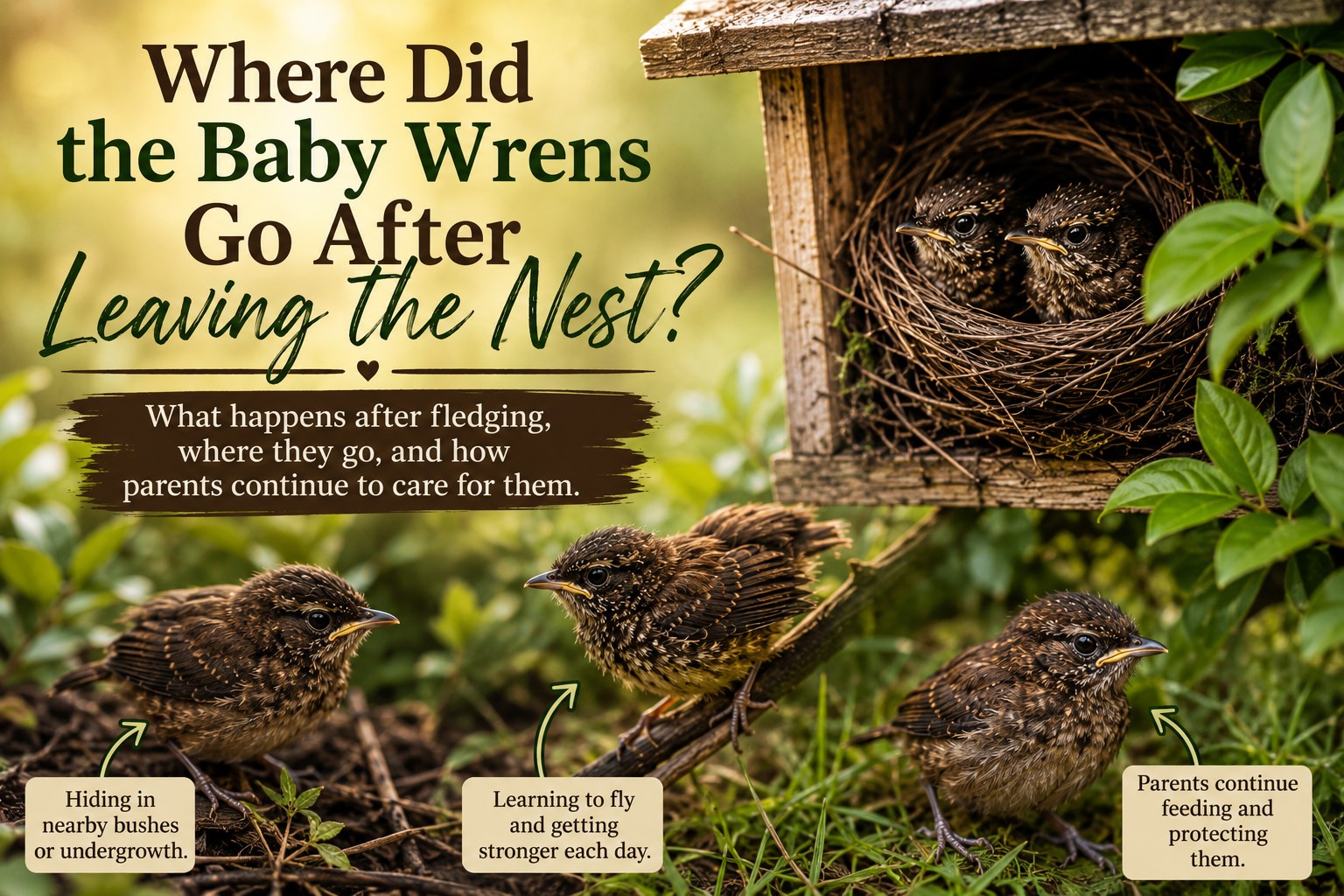
<p data-start="1711" data-end="1870">Baby wrens often flutter awkwardly to the ground, hop between branches, hide under bushes, or cling to low vegetation while they build strength and confidence.</p>
<p data-start="1872" data-end="1924">It can look alarming if you've never seen it before.</p>
<h2 data-section-id="175uvv8" data-start="1926" data-end="1946">Where Do They Go?</h2>
<p data-start="1948" data-end="2015">Once the babies leave the nest, they usually don't travel very far.</p>
<p data-start="2017" data-end="2069">In fact, they're often hiding only a few yards away.</p>
<p data-start="2071" data-end="2221">They naturally seek dense shrubs, thick bushes, low tree branches, brush piles, or other sheltered areas where predators are less likely to find them.</p>
<p data-start="2223" data-end="2337">Because they're so well camouflaged, you can easily walk right past a fledgling without ever realizing it's there.</p>
<h2 data-section-id="z31ch4" data-start="2339" data-end="2376">The Parents Haven't Abandoned Them</h2>
<p data-start="2378" data-end="2499">One of the biggest surprises for us was learning that leaving the nest doesn't mean the babies are suddenly on their own.</p>
<p data-start="2501" data-end="2513">Far from it.</p>
<p data-start="2515" data-end="2616">Both parent wrens continue feeding and protecting their young for another week or two after fledging.</p>
<p data-start="2618" data-end="2749">During this time, the parents know exactly where each youngster is hiding and visit them regularly with insects throughout the day.</p>
<p data-start="2751" data-end="2827">Even if you never see the fledglings again, the parents almost certainly do.</p>
<h2 data-section-id="13apzme" data-start="2829" data-end="2860">Our Own Carolina Wren Family</h2>
<p data-start="2862" data-end="2946">When our four little wrens finally left their nest, the silence felt almost strange.</p>
<p data-start="2948" data-end="3098">After weeks of constant chirping and watching the parents arrive every few minutes with food, it was hard to believe the nest could suddenly be empty.</p>
<p data-start="3100" data-end="3176">For much of that day we could still hear Birdie and her mate calling nearby.</p>
<p data-start="3178" data-end="3243">At first, we wondered whether they were searching for the babies.</p>
<p data-start="3245" data-end="3395">Later, we learned those calls were likely part of normal communication between the parents and their newly fledged youngsters hidden somewhere nearby.</p>
<p data-start="3397" data-end="3543">Although we never saw all four babies together again, it was comforting to know that their story hadn't ended—it had simply moved beyond the nest.</p>
<h2 data-section-id="aurnw6" data-start="3545" data-end="3576">Should You Help a Baby Wren?</h2>
<p data-start="3578" data-end="3588">Usually...</p>
<p data-start="3590" data-end="3593">No.</p>
<p data-start="3595" data-end="3716">If a young bird is fully feathered, alert, hopping around, and doesn't appear injured, it's almost certainly a fledgling.</p>
<p data-start="3718" data-end="3760">This is exactly where it's supposed to be.</p>
<p data-start="3762" data-end="3858">Although it may look vulnerable, its parents are usually close by and continuing to care for it.</p>
<p data-start="3860" data-end="3889">The best thing you can do is:</p>
<ul data-start="3891" data-end="4106">
<li data-section-id="1qoyn6w" data-start="3891" data-end="3923">Keep cats indoors if possible.</li>
<li data-section-id="175pv08" data-start="3924" data-end="3982">Keep dogs away from the immediate area for a short time.</li>
<li data-section-id="pet2o8" data-start="3983" data-end="4009">Observe from a distance.</li>
<li data-section-id="1fukks8" data-start="4010" data-end="4106">Resist the urge to move or rescue the bird unless it's clearly injured or in immediate danger.</li>
</ul>
<p data-start="4108" data-end="4143">Nature often knows what it's doing.</p>
<h2 data-section-id="1n1icu8" data-start="4145" data-end="4177">Will They Return to the Nest?</h2>
<p data-start="4179" data-end="4263">One question we asked ourselves was whether we'd see the babies return that evening.</p>
<p data-start="4265" data-end="4282">The answer is no.</p>
<p data-start="4284" data-end="4354">Once Carolina Wrens leave the nest, they generally don't move back in.</p>
<p data-start="4356" data-end="4504">Instead, they spend their nights hidden in thick vegetation while continuing to follow their parents as they learn to find food and avoid predators.</p>
<p data-start="4506" data-end="4538">The nest has served its purpose.</p>
<p data-start="4540" data-end="4575">Now it's time for the next chapter.</p>
<h2 data-section-id="r0p4h5" data-start="4577" data-end="4592">Looking Back</h2>
<p data-start="4594" data-end="4760">Watching our Carolina Wren family from the very first twig to the day the babies left the nest has been one of the most rewarding wildlife experiences we've ever had.</p>
<p data-start="4762" data-end="4851">It reminded us that sometimes the most exciting parts of nature happen just out of sight.</p>
<p data-start="4853" data-end="4964">The nest may be empty now, but somewhere nearby, four young wrens are learning how to become independent birds.</p>
<p data-start="4966" data-end="5018">And that's exactly how the story is supposed to end.</p>
<p data-start="5020" data-end="5033">Or perhaps...</p>
<p data-start="5035" data-end="5063">How the next chapter begins.</p>
<p data-section-id="pzrtqt" data-start="5070" data-end="5113"><em>Videos documenting this entire journey will be available through YouTube shortly.</em></p>
            ]]>
        </content>
    </entry>
    <entry>
        <title>The Day the Baby Wrens Left the Nest: A Bittersweet End to Our Carolina Wren Journey</title>
        <author>
            <name>Rachy</name>
        </author>
        <link href="https://alabamanaturenotes.com/day-baby-carolina-wrens-left-the-nest/"/>
        <id>https://alabamanaturenotes.com/day-baby-carolina-wrens-left-the-nest/</id>
        <media:content url="https://alabamanaturenotes.com/media/posts/20/fledging.png" medium="image" />
            <category term="Wildlife Observation"/>
            <category term="Wildlife"/>
            <category term="Nature Journal"/>
            <category term="Nature Diary"/>
            <category term="Fledging Birds"/>
            <category term="Carolina Wren Nest"/>
            <category term="Carolina Wren"/>
            <category term="Bird Watching"/>
            <category term="Bird Nest"/>
            <category term="Bird Behavior"/>
            <category term="Backyard Birds"/>
            <category term="Baby Birds"/>
            <category term="Alabama Wildlife"/>
            <category term="Alabama Nature Notes"/>
            <category term="2026 Carolina Wren Nest Journal"/>

        <updated>2026-07-03T20:37:01-05:00</updated>
            <summary type="html">
                <![CDATA[
                        <img src="https://alabamanaturenotes.com/media/posts/20/fledging.png" alt="" />
                    For weeks, our little Carolina Wren family became part of our daily&hellip;
                ]]>
            </summary>
        <content type="html">
            <![CDATA[
                    <p><img src="https://alabamanaturenotes.com/media/posts/20/fledging.png" class="type:primaryImage" alt="" /></p>
                <p data-start="492" data-end="568">For weeks, our little Carolina Wren family became part of our daily routine.</p>
<p data-start="570" data-end="959">What started as a tiny nest tucked away in an old cupboard on our deck quickly turned into one of the most fascinating wildlife experiences we've ever had. Every morning we'd quietly check in on Birdie and her growing family, watching eggs appear one by one, waiting patiently for them to hatch, and then spending countless hours observing four hungry little chicks grow stronger each day.</p>
<p data-start="961" data-end="1013">Nothing, however, prepared us for the day they left.</p>
<h2 data-section-id="9se4z7" data-start="1015" data-end="1053">It Happened Faster Than We Expected</h2>
<p data-start="1055" data-end="1105">We knew the babies were getting close to fledging.</p>
<p data-start="1107" data-end="1328">Their tiny featherless bodies had transformed into energetic young birds with bright eyes, fluffy feathers, and endless appetites. Every day they seemed larger, louder, and more curious about the world outside their nest.</p>
<p data-start="1330" data-end="1463">Even knowing they were nearly ready, we still expected to wake up one morning and find them calmly waiting for breakfast like always.</p>
<p data-start="1465" data-end="1516">Instead, the day took a completely unexpected turn.</p>
<h2 data-section-id="4i2ur9" data-start="1518" data-end="1556">One Little Wren Made the First Leap</h2>
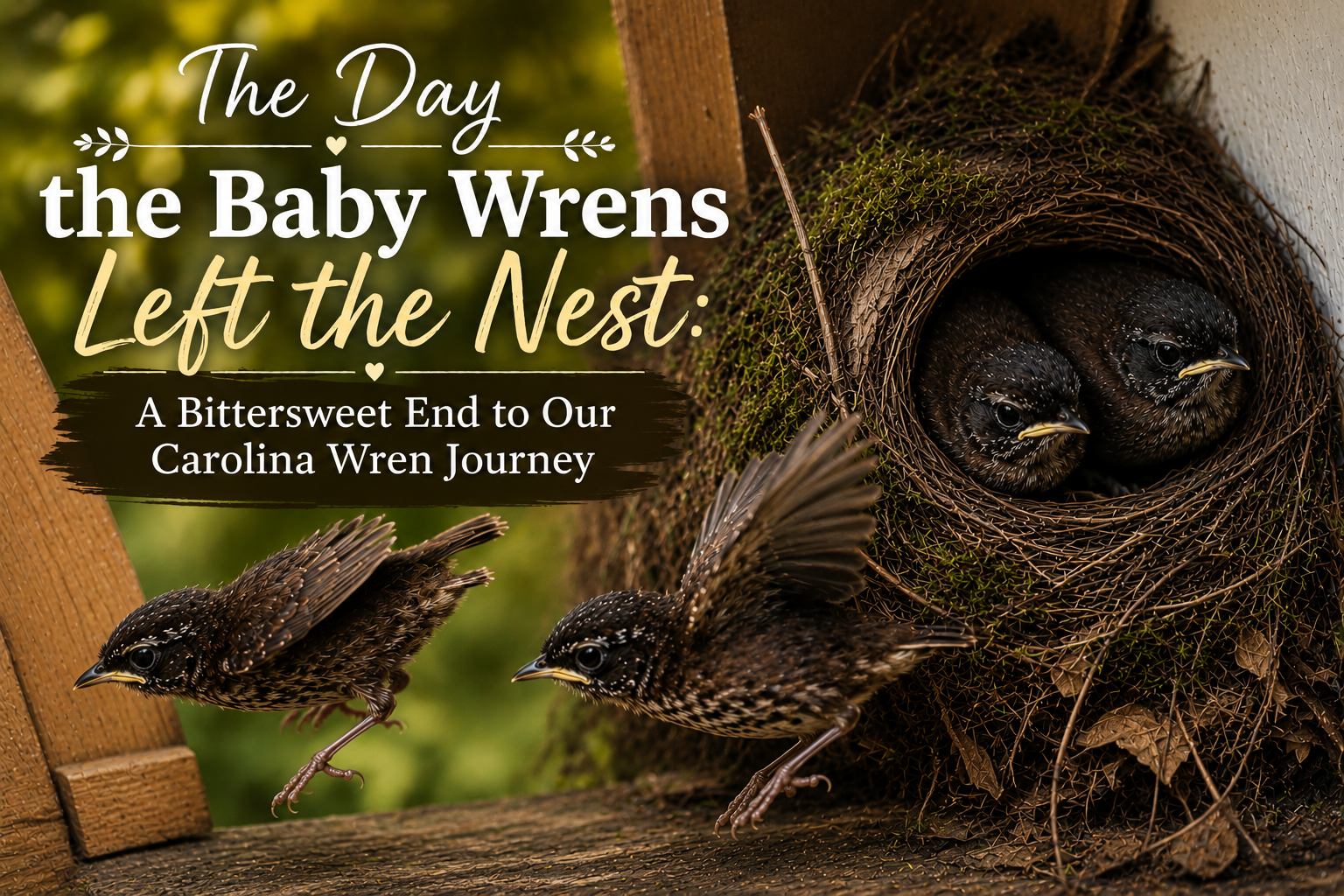
<p data-start="1558" data-end="1638">While checking on the nest, one of the young wrens suddenly launched itself out.</p>
<p data-start="1640" data-end="1679">It all happened in a matter of seconds.</p>
<p data-start="1681" data-end="1819">The tiny bird cleared the edge of the nest, fluttered down onto our deck, and disappeared before we had time to process what had happened.</p>
<p data-start="1821" data-end="1876">Like many people would, our first instinct was to help.</p>
<p data-start="1878" data-end="2175">Looking back now, we realize that fledging can look far more dramatic than most people expect. Young birds often leave the safety of the nest before they're strong fliers, spending their first days hopping, fluttering, hiding, and learning while their parents continue feeding and protecting them.</p>
<p data-start="2177" data-end="2223">At the time, though, it was hard not to worry.</p>
<h2 data-section-id="1nlsfep" data-start="2225" data-end="2250">The Rest Soon Followed</h2>
<p data-start="2252" data-end="2312">Not long afterward, the remaining chicks also left the nest.</p>
<p data-start="2314" data-end="2412">One moment the nest that had been overflowing with four busy little wrens was alive with movement.</p>
<p data-start="2414" data-end="2425">The next...</p>
<p data-start="2427" data-end="2440">It was empty.</p>
<p data-start="2442" data-end="2534">After spending weeks watching this family every single day, the silence felt almost strange.</p>
<p data-start="2536" data-end="2572">No tiny heads peeking over the edge.</p>
<p data-start="2574" data-end="2610">No constant chorus of hungry chirps.</p>
<p data-start="2612" data-end="2667">No parents arriving every few minutes carrying insects.</p>
<p data-start="2669" data-end="2688">Just an empty nest.</p>
<h2 data-section-id="kx3u2o" data-start="2690" data-end="2724">We Could Still Hear the Parents</h2>
<p data-start="2726" data-end="2777">Although the nest was empty, the story wasn't over.</p>
<p data-start="2779" data-end="2859">Throughout the day we could hear the familiar calls of both parent wrens nearby.</p>
<p data-start="2861" data-end="2959">For a while we weren't sure whether they were searching for the babies or communicating with them.</p>
<p data-start="2961" data-end="3196">As we later learned, Carolina Wren parents continue caring for their fledglings after they leave the nest. The young birds scatter into nearby shrubs, trees, and thick vegetation where they stay hidden while learning to fly and forage.</p>
<p data-start="3198" data-end="3238">The parents know exactly where they are.</p>
<p data-start="3240" data-end="3323">Even when we couldn't see them anymore, Birdie and her mate almost certainly could.</p>
<h2 data-section-id="15wjoka" data-start="3325" data-end="3372">An Empty Nest Doesn't Mean the Story Is Over</h2>
<p data-start="3374" data-end="3503">One thing I didn't fully appreciate before this experience is that leaving the nest is only the beginning of a young bird's life.</p>
<p data-start="3505" data-end="3554">Fledglings still depend heavily on their parents.</p>
<p data-start="3556" data-end="3697">Over the next week or two they'll continue receiving food while practicing short flights, building strength, and slowly becoming independent.</p>
<p data-start="3699" data-end="3763">Although they're out of sight, they're still very much a family.</p>
<h2 data-section-id="r0p4h5" data-start="3765" data-end="3780">Looking Back</h2>
<p data-start="3782" data-end="3945">Watching this Carolina Wren family from the very first twig to the day the chicks flew away has been one of the most rewarding wildlife experiences we've ever had.</p>
<p data-start="3947" data-end="3980">Along the way we learned so much:</p>
<ul data-start="3982" data-end="4318">
<li data-section-id="um82hr" data-start="3982" data-end="4048">Carolina Wrens don't always sleep in the nest with older chicks.</li>
<li data-section-id="3fnbym" data-start="4049" data-end="4109">Parents work almost nonstop to keep growing nestlings fed.</li>
<li data-section-id="1etjpho" data-start="4110" data-end="4194">Baby birds produce tiny fecal sacs that parents carry away to keep the nest clean.</li>
<li data-section-id="8ed0un" data-start="4195" data-end="4254">The nest becomes incredibly crowded surprisingly quickly.</li>
<li data-section-id="88hlmk" data-start="4255" data-end="4318">Fledging can happen suddenly, often when you least expect it.</li>
</ul>
<p data-start="4320" data-end="4410">Most importantly, we learned that nature doesn't always unfold the way we imagine it will.</p>
<p data-start="4412" data-end="4479">Sometimes the most emotional moments happen in the blink of an eye.</p>
<h2 data-section-id="1dcdz6n" data-start="4481" data-end="4503">Will Birdie Return?</h2>
<p data-start="4505" data-end="4591">One question we're already wondering is whether Birdie will decide to nest here again.</p>
<p data-start="4593" data-end="4851">Carolina Wrens often raise multiple broods during a breeding season, although they don't usually reuse the exact same nest. If she chooses our little corner of Alabama again, we'll be ready with our cameras—and hopefully a little less panic this time around.</p>
<p data-start="4853" data-end="4961">If she doesn't, we'll always be grateful that she trusted our backyard long enough to raise her family here.</p>
<h2 data-section-id="1rhrev7" data-start="4963" data-end="4983">Thank You, Birdie</h2>
<p data-start="4985" data-end="5059">It's funny how attached you can become to wild birds you've never touched.</p>
<p data-start="5061" data-end="5217">For weeks, our days revolved around checking on this little family, celebrating every milestone, and worrying whenever something seemed out of the ordinary.</p>
<p data-start="5219" data-end="5259">Then one day, just as nature intended...</p>
<p data-start="5261" data-end="5276">They were gone.</p>
<p data-start="5278" data-end="5412">The nest may now be empty, but the memories—and the hundreds of photos and videos we captured along the way—will stay with us forever.</p>
<p data-start="5414" data-end="5468">Thanks for letting us be part of your journey, Birdie.</p>
<p data-start="5470" data-end="5538">We'll be watching the skies, just in case you decide to visit again.</p>
<p data-start="5470" data-end="5538"><em>Videos documenting this entire journey will be available through YouTube shortly.</em></p>
            ]]>
        </content>
    </entry>
    <entry>
        <title>One Sleepless Night With Our Carolina Wren Family: When a Nest Became Too Crowded</title>
        <author>
            <name>Rachy</name>
        </author>
        <link href="https://alabamanaturenotes.com/carolina-wren-nestlings-fell-from-nest/"/>
        <id>https://alabamanaturenotes.com/carolina-wren-nestlings-fell-from-nest/</id>
        <media:content url="https://alabamanaturenotes.com/media/posts/19/wrennestfall.png" medium="image" />
            <category term="Wildlife Journal"/>
            <category term="Nestlings"/>
            <category term="Nature Diary"/>
            <category term="Fledging Birds"/>
            <category term="Carolina Wren Nest"/>
            <category term="Carolina Wren"/>
            <category term="Bird Watching"/>
            <category term="Bird Nest"/>
            <category term="Backyard Birds"/>
            <category term="Baby Birds"/>
            <category term="Alabama Nature Notes"/>
            <category term="Alabama Birds"/>

        <updated>2026-07-01T19:13:44-05:00</updated>
            <summary type="html">
                <![CDATA[
                        <img src="https://alabamanaturenotes.com/media/posts/19/wrennestfall.png" alt="One Sleepless Night" />
                    One of the most rewarding parts of watching wildlife is seeing nature&hellip;
                ]]>
            </summary>
        <content type="html">
            <![CDATA[
                    <p><img src="https://alabamanaturenotes.com/media/posts/19/wrennestfall.png" class="type:primaryImage" alt="One Sleepless Night" /></p>
                <p>One of the most rewarding parts of watching wildlife is seeing nature unfold right before your eyes.</p>
<p class="isSelectedEnd">One of the hardest parts is realizing how attached you've become.</p>
<p class="isSelectedEnd">Our little Carolina Wren family has been nesting on top of a cupboard on our back deck for weeks now. We've watched the parents build their nest twig by twig, celebrated each new egg, and recently welcomed four hungry little chicks into the world. Every day they've grown a little bigger, a little louder, and a little stronger.</p>
<p class="isSelectedEnd">Last night, though, reminded me just how quickly things can change.</p>
<h2>A Missing Baby</h2>
<p class="isSelectedEnd">Before heading to bed, I quietly stepped outside to check on the nest one last time.</p>
<p class="isSelectedEnd">Something immediately looked different.</p>
<p class="isSelectedEnd">There weren't four little heads peeking up anymore.</p>
<p class="isSelectedEnd">There were only three.</p>
<p class="isSelectedEnd">My heart sank.</p>
<p class="isSelectedEnd">Since it was sometime between midnight and 3:00 a.m., Mama Wren and her companion were away for the night, leaving the babies tucked together in the nest. We carefully searched around the cupboard, hoping the missing chick hadn't gone far.</p>
<p class="isSelectedEnd">Then I spotted them.</p>
<p class="isSelectedEnd">The tiny nestling was sitting on the deck beneath the cupboard.</p>
<p class="isSelectedEnd">Relieved that they appeared unharmed, I gently picked them up and placed them back into the nest with their siblings.</p>
<p class="isSelectedEnd">At first I wondered if the little one had somehow climbed out, but the more I watched the nest over the following hours, the more I realized that probably wasn't what had happened at all.</p>
<p class="isSelectedEnd">The chicks are growing incredibly fast, yet the nest itself isn't getting any bigger. In fact, it almost seems to be shrinking as their fluffy little bodies fill every available inch of space. They're constantly wriggling, stretching, and pushing against one another, especially when they're hungry or trying to get comfortable.</p>
<p class="isSelectedEnd">It seems far more likely that this little one had simply been pushed over the edge by accident.</p>
<h2>An Unexpected Flap of Tiny Wings</h2>
<p class="isSelectedEnd">While returning the first chick, I noticed another baby sitting just outside the nest.</p>
<p class="isSelectedEnd">They weren't on the floor this time. They were resting nearby, looking surprisingly peaceful, almost as if they had drifted off to sleep.</p>
<p class="isSelectedEnd">I carefully reached down and scooped them up.</p>
<p class="isSelectedEnd">The moment they felt my hand, they suddenly flapped their tiny wings and launched themselves into the air.</p>
<p class="isSelectedEnd">For a split second, my heart stopped.</p>
<p class="isSelectedEnd">They only flew a short distance before landing safely on one of the lower shelves of the cupboard, but for those few seconds it felt like forever.</p>
<p class="isSelectedEnd">After a careful search, we found them sitting quietly, completely unharmed, and gently returned them to the nest.</p>
<p class="isSelectedEnd">Once again, all four babies were together.</p>
<p class="isSelectedEnd">Or so we thought.</p>
<h2>One More Surprise</h2>
<p class="isSelectedEnd">After getting ready for bed, I couldn't shake the feeling that I should check on them one last time.</p>
<p class="isSelectedEnd">I'm so glad I did.</p>
<p class="isSelectedEnd">One chick was missing again.</p>
<p class="isSelectedEnd">This time we found it had fallen and was squeezed into the narrow space between the cupboard and our glass deck doors.</p>
<p class="isSelectedEnd">Once again, they seemed perfectly fine—just in the wrong place.</p>
<p class="isSelectedEnd">I carefully lifted the little bird and tucked them back beside their brothers and sisters.</p>
<p class="isSelectedEnd">By now it had become obvious that the nest was simply becoming too crowded for four rapidly growing wrens.</p>
<h2>A Little Peace of Mind</h2>
<p class="isSelectedEnd">By this point, hubby and I were both worried that another accidental tumble might happen before morning.</p>
<p class="isSelectedEnd">He came up with a simple idea.</p>
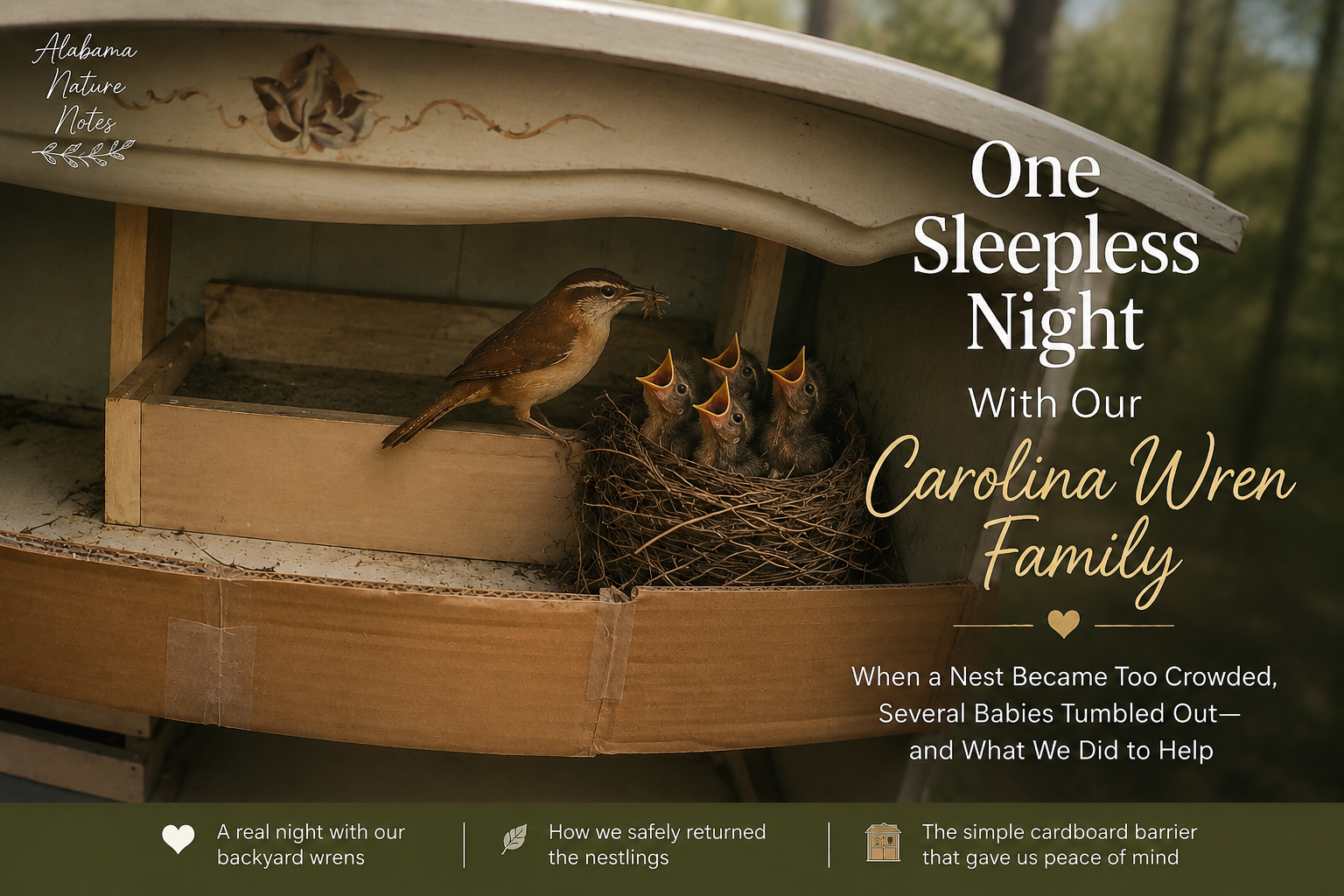
<p class="isSelectedEnd">Using a piece of cardboard and some tape, we created a small temporary barrier along the open edge beside the nest. It wasn't ever meant to keep the chicks trapped inside or anything—it was only to prevent another accidental fall while they continue growing stronger.</p>
<p class="isSelectedEnd">As simple as it was, it gave us a little peace of mind.</p>
<h2>Would Mama Still Come Back?</h2>
<p class="isSelectedEnd">Even after we came inside, I couldn't stop thinking about them.</p>
<p class="isSelectedEnd">Would the cardboard bother Mama?</p>
<p class="isSelectedEnd">Would she notice that we'd handled one—or maybe two—of her babies?</p>
<p class="isSelectedEnd">Would she reject the nest?</p>
<p class="isSelectedEnd">Those thoughts stayed with me for most of the night.</p>
<p class="isSelectedEnd">I hardly slept.</p>
<p class="isSelectedEnd">As soon as morning arrived, I found myself watching from the camera we have set up. Like clockwork she returns around 5:30am every day to begin feeding the little ones.</p>
<p class="isSelectedEnd">Before long, Mama Wren appeared carrying breakfast.</p>
<p class="isSelectedEnd">She landed near the nest, paused for a brief moment, and seemed to glance around as though something looked slightly different.</p>
<p class="isSelectedEnd">Then, without any hesitation, she hopped over and began feeding her babies just as she always does. She even landed on the carboard barrier a few times, making me feel like she accepted it and understood why it was there.</p>
<p class="isSelectedEnd">The relief I felt in that moment is hard to describe.</p>
<p class="isSelectedEnd">Life carried on exactly as it should. Thankfully!</p>
<h2>Growing Up Fast</h2>
<p class="isSelectedEnd">Watching these little wrens has been such a privilege. It's not every day that you get to see how they live, how they eat, what their lives are like in such an up close and personal way. They are just outside our glass deck doors, and we watch from the camera most days, not going near the nest too much for fear of upsetting mama and companion.</p>
<p class="isSelectedEnd">Only days ago they were tiny hatchlings with closed eyes, completely dependent on their parents.</p>
<p class="isSelectedEnd">Now they're feathering up, stretching their wings, and filling every corner of their once-spacious nest. I think next time, mama should maybe make a bigger nest. </p>
<p class="isSelectedEnd">Their first flight into the world can't be too far away.</p>
<p>I've come to really appreciate their enchanged little chirps and songs, and will definitely miss that when they are gone from the nest, and out in the world.</p>
<p class="isSelectedEnd">As excited as I am to see that milestone, I already know I'll probably spend the next few days worrying every time I hear a flutter outside.</p>
<p class="isSelectedEnd">That's the funny thing about inviting wildlife into your life.</p>
<p class="isSelectedEnd">You begin by simply observing.</p>
<p class="isSelectedEnd">Before long, you're quietly cheering them on, celebrating every little milestone, and losing sleep over four tiny birds that have no idea how much joy they've brought to your home, or how much they are being protected and cared for from afar.</p>
<p>Hopefully mama and companion know that they secretly had humans on their side helping them along in this journey.</p>
<div><hr></div>
<h3>A Quick Note About Baby Birds</h3>
<p class="isSelectedEnd">If you ever find a young bird that has accidentally fallen from an accessible nest and it appears healthy and uninjured, gently placing it back into the nest is generally the best course of action. Despite the old myth, most parent birds do <strong>not</strong> abandon their chicks simply because a human has touched them. It's still important to keep handling to an absolute minimum and leave the area promptly so the parents can return to caring for their young.</p>
<p>Every situation is different, though. If a chick is injured, cold, or the nest can't be reached safely, contact a licensed wildlife rehabilitator for guidance.</p>
            ]]>
        </content>
    </entry>
    <entry>
        <title>What Are These Strange Mud Blobs on My Bird Feeder?</title>
        <author>
            <name>Rachy</name>
        </author>
        <link href="https://alabamanaturenotes.com/strange-mud-blobs-on-bird-feeder/"/>
        <id>https://alabamanaturenotes.com/strange-mud-blobs-on-bird-feeder/</id>
        <media:content url="https://alabamanaturenotes.com/media/posts/18/mudblobs.png" medium="image" />
            <category term="wildlife photography"/>
            <category term="spiders"/>
            <category term="solitary wasps"/>
            <category term="rural Alabama"/>
            <category term="nature notes"/>
            <category term="nature blog"/>
            <category term="native insects"/>
            <category term="mud wasp"/>
            <category term="mud nests"/>
            <category term="mud dauber nests"/>
            <category term="mud dauber"/>
            <category term="insect nests"/>
            <category term="garden wildlife"/>
            <category term="bird feeder insects"/>
            <category term="bird feeder"/>
            <category term="beneficial insects"/>
            <category term="backyard wildlife"/>
            <category term="backyard discoveries"/>
            <category term="Alabama nature"/>
            <category term="Alabama Wildlife"/>

        <updated>2026-06-27T17:25:05-05:00</updated>
            <summary type="html">
                <![CDATA[
                        <img src="https://alabamanaturenotes.com/media/posts/18/mudblobs.png" alt="" />
                    Sometimes the most fascinating discoveries aren't found deep in the woods—they're hanging&hellip;
                ]]>
            </summary>
        <content type="html">
            <![CDATA[
                    <p><img src="https://alabamanaturenotes.com/media/posts/18/mudblobs.png" class="type:primaryImage" alt="" /></p>
                <p class="isSelectedEnd">Sometimes the most fascinating discoveries aren't found deep in the woods—they're hanging right outside your back door.</p>
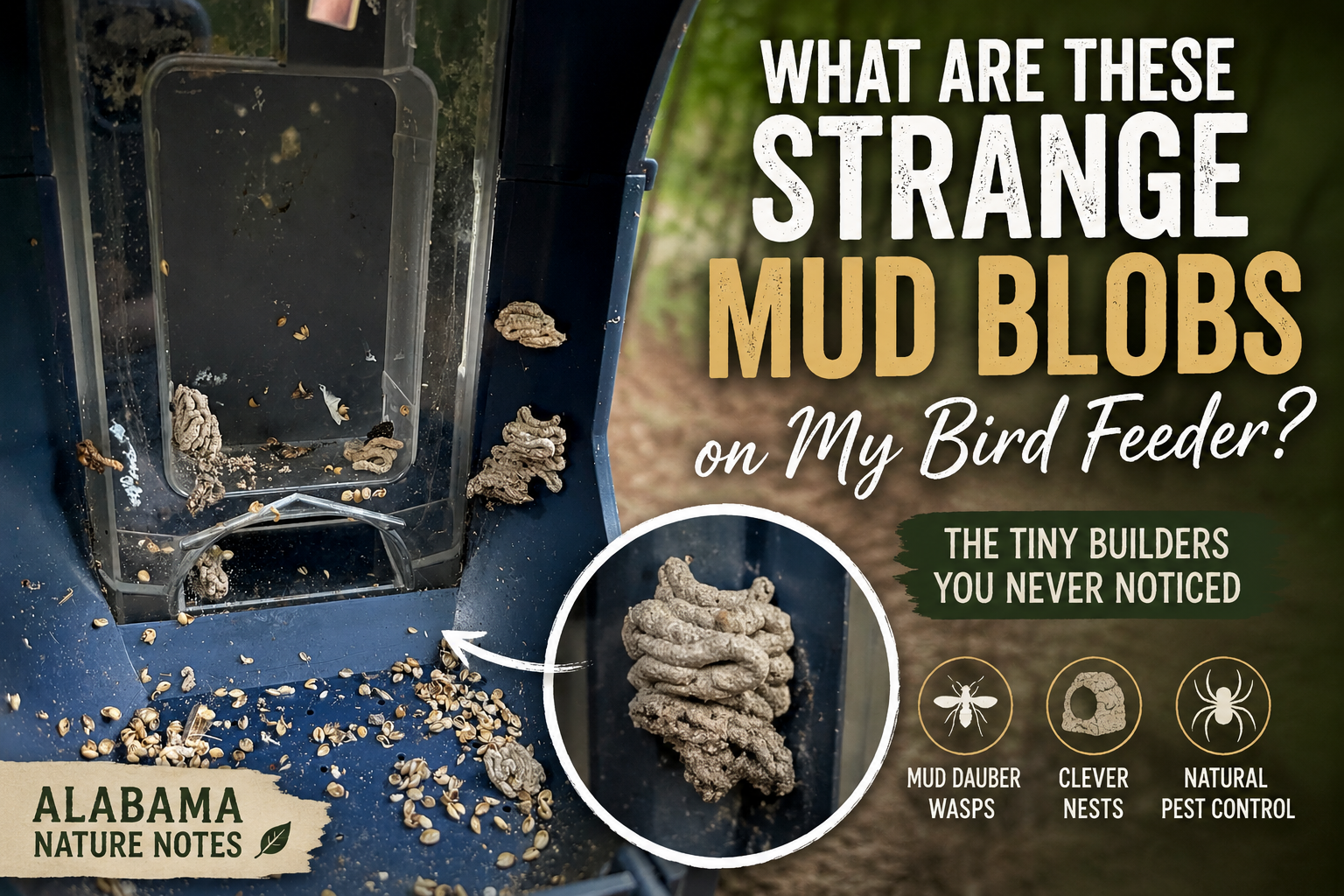
<p class="isSelectedEnd">While walking out onto our deck recently, I noticed something unusual on an old bird feeder that hadn't been filled in quite some time. Attached to both the inside and outside of the feeder were several strange gray lumps that looked almost like tiny brains made of dried clay.</p>
<p class="isSelectedEnd">At first glance, I had no idea what they were.</p>
<p class="isSelectedEnd">My first thought was that they might be some kind of fungus or perhaps an insect egg mass. But a closer look revealed a rough, layered texture, almost as if someone had carefully stacked tiny ropes of mud on top of one another.</p>
<p class="isSelectedEnd">Nature had quietly been busy while I wasn't paying attention.</p>
<h2>Tiny Master Builders</h2>
<p class="isSelectedEnd">These curious structures are most likely the nests of solitary mud-building wasps, commonly known as mud daubers or one of their close relatives.</p>
<p class="isSelectedEnd">Unlike yellowjackets or hornets, these wasps don't live in large colonies. Each female works completely alone, acting as both architect and provider for her future offspring.</p>
<p class="isSelectedEnd">Using nothing more than tiny mouthfuls of wet mud collected from puddles or damp soil, she slowly builds one chamber at a time. Every trip adds another thin layer until a nursery is complete.</p>
<p class="isSelectedEnd">It's remarkable to think that each of these little nests was built pellet by pellet by an insect only about an inch long.</p>
<h2>Why My Bird Feeder?</h2>
<p class="isSelectedEnd">From a wasp's perspective, an empty bird feeder is prime real estate.</p>
<p class="isSelectedEnd">It's sheltered from rain.</p>
<p class="isSelectedEnd">It's protected from harsh sunlight.</p>
<p class="isSelectedEnd">It's attached to a solid surface.</p>
<p class="isSelectedEnd">And since the feeder hadn't been used for a while, it probably wasn't disturbed very often.</p>
<p class="isSelectedEnd">To us, it's an old feeder.</p>
<p class="isSelectedEnd">To a solitary wasp, it's the perfect place to raise a family.</p>
<h2>A Nursery... Not a Home</h2>
<p class="isSelectedEnd">Although they look like miniature apartments, these mud structures aren't permanent homes.</p>
<p class="isSelectedEnd">Each chamber serves a single purpose.</p>
<p class="isSelectedEnd">After building the cell, the female hunts for spiders or, depending on the species, small caterpillars. She stings them, which paralyzes—but usually doesn't kill—them.</p>
<p class="isSelectedEnd">She then places several of these motionless meals inside the chamber before laying a single egg.</p>
<p class="isSelectedEnd">Finally, she seals the entrance with more mud and flies away.</p>
<p class="isSelectedEnd">When the egg hatches, the developing larva has a fresh food supply waiting for it. Once it has grown large enough, it forms a cocoon, transforms into an adult wasp, and eventually chews its way out, leaving behind a neat little exit hole.</p>
<h2>Nature's Pest Control</h2>
<p class="isSelectedEnd">While many people become nervous whenever they hear the word "wasp," solitary mud wasps are among the gentlest wasps you'll find in Alabama.</p>
<p class="isSelectedEnd">They rarely sting people because they have no colony to defend.</p>
<p class="isSelectedEnd">Instead, they spend their days hunting spiders and other small creatures that many homeowners would rather not have around.</p>
<p class="isSelectedEnd">In other words, these tiny builders are quietly helping keep backyard ecosystems in balance.</p>
<h2>Looking a Little Closer</h2>
<p class="isSelectedEnd">The nests on our feeder vary in size, with some consisting of just a single chamber while others are clustered together in irregular groups.</p>
<p class="isSelectedEnd">Their wrinkled appearance makes them look almost sculpted by hand.</p>
<p class="isSelectedEnd">I have no idea how long they've been there. It's entirely possible they were built while I was busy watching our Carolina Wrens raise their family just a few feet away.</p>
<p class="isSelectedEnd">It's amazing how much wildlife shares our yards without us ever noticing.</p>
<h2>Nature Never Stops Surprising Me</h2>
<p class="isSelectedEnd">One of the things I love most about spending time outdoors is discovering something new that I had walked past dozens of times before.</p>
<p class="isSelectedEnd">An abandoned bird feeder became home to a completely different creature.</p>
<p class="isSelectedEnd">What first looked like strange blobs of dried mud turned out to be carefully constructed nurseries built by one of Alabama's most overlooked insects.</p>
<p class="isSelectedEnd">It makes me wonder...</p>
<p class="isSelectedEnd">How many other tiny stories are unfolding around us every day without us even realizing they're there?</p>
<p class="isSelectedEnd">Maybe all it takes is slowing down long enough to notice.</p>
<div><hr></div>
<p><strong>Have you ever found mud nests attached to your porch, shed, mailbox, or bird feeder? I'd love to hear about your discoveries in the comments!</strong></p>
            ]]>
        </content>
    </entry>
    <entry>
        <title>10 Strange Alabama Wildlife Laws I Bet You Never Knew Existed</title>
        <author>
            <name>Rachy</name>
        </author>
        <link href="https://alabamanaturenotes.com/strange-alabama-wildlife-laws/"/>
        <id>https://alabamanaturenotes.com/strange-alabama-wildlife-laws/</id>
        <media:content url="https://alabamanaturenotes.com/media/posts/17/allaws.png" medium="image" />
            <category term="Wildlife Laws"/>
            <category term="Wildlife Education"/>
            <category term="Wildlife Conservation"/>
            <category term="Reptiles"/>
            <category term="Outdoor Alabama"/>
            <category term="Nature Facts"/>
            <category term="Black Bears"/>
            <category term="Birds"/>
            <category term="Alabama Wildlife"/>

        <updated>2026-06-27T15:38:22-05:00</updated>
            <summary type="html">
                <![CDATA[
                        <img src="https://alabamanaturenotes.com/media/posts/17/allaws.png" alt="AL Laws" />
                    When most people think about Alabama wildlife laws, they probably imagine hunting&hellip;
                ]]>
            </summary>
        <content type="html">
            <![CDATA[
                    <p><img src="https://alabamanaturenotes.com/media/posts/17/allaws.png" class="type:primaryImage" alt="AL Laws" /></p>
                <p class="isSelectedEnd">When most people think about Alabama wildlife laws, they probably imagine hunting seasons or fishing licenses.</p>
<p class="isSelectedEnd">But there are actually quite a few surprising rules designed to protect our native wildlife—some of which might catch you completely off guard.</p>
<p class="isSelectedEnd">Over the years, I've learned that many things people do with good intentions—like taking home a baby turtle or rescuing a "lost" fawn—can actually be illegal or harmful to the animal.</p>
<p class="isSelectedEnd">Here are ten Alabama wildlife laws (and regulations) that I found especially interesting.</p>
<div><hr></div>
<h2>🐢 1. You Can't Keep a Box Turtle Just Because You Found It</h2>
<p class="isSelectedEnd">Box turtles are one of Alabama's most recognizable reptiles, and many people assume they can take one home if they find it crossing a trail.</p>
<p class="isSelectedEnd">In reality, Alabama regulations protect native box turtles. There are strict limits on possessing them, and selling or trading them generally isn't allowed without the proper permits.</p>
<p class="isSelectedEnd">The best thing you can do if you find one?</p>
<p class="isSelectedEnd">Simply leave it where it is—or, if it's crossing a road, carefully move it to the side it was already heading toward.</p>
<div><hr></div>
<h2>🦌 2. That "Abandoned" Baby Deer Probably Isn't Abandoned</h2>
<p class="isSelectedEnd">Every spring, wildlife rehabilitators receive countless phone calls from people who believe they've found an orphaned fawn.</p>
<p class="isSelectedEnd">The truth is that mother deer commonly leave their babies hidden for several hours while they feed elsewhere.</p>
<p class="isSelectedEnd">Taking the fawn home is not only unnecessary in most cases—it may also violate wildlife regulations.</p>
<p class="isSelectedEnd">If the fawn appears healthy and isn't in immediate danger, the best thing to do is simply leave it alone.</p>
<div><hr></div>
<h2>🐦 3. You Can't Keep a Baby Bird You Found</h2>
<p class="isSelectedEnd">Finding a baby bird on the ground can tug at anyone's heartstrings.</p>
<p class="isSelectedEnd">However, nearly all native songbirds are protected by both Alabama regulations and federal law.</p>
<p class="isSelectedEnd">If a nestling has fallen from its nest, it's perfectly okay to gently place it back if you can safely reach it. Contrary to popular belief, the parents won't reject it because you've touched it.</p>
<div><hr></div>
<h2>🦝 4. Wild Raccoons Don't Make Legal Pets</h2>
<p class="isSelectedEnd">Baby raccoons might look adorable, but Alabama law doesn't allow people to simply adopt one they find in the wild.</p>
<p class="isSelectedEnd">Wild animals require specialized diets, veterinary care, and often carry diseases or parasites that make them unsuitable as pets.</p>
<p class="isSelectedEnd">Licensed wildlife rehabilitators are the people best equipped to care for orphaned raccoons.</p>
<div><hr></div>
<h2>🐻 5. Feeding Bears Is Never a Good Idea</h2>
<p class="isSelectedEnd">While black bears are still relatively uncommon in many parts of Alabama, their numbers are slowly increasing.</p>
<p class="isSelectedEnd">Feeding bears intentionally—or accidentally by leaving pet food or garbage outside—can teach them to associate people with food.</p>
<p class="isSelectedEnd">That creates dangerous situations for both bears and humans.</p>
<p class="isSelectedEnd">Remember: a fed bear is often a dead bear.</p>
<div><hr></div>
<h2>🦇 6. Many Alabama Bats Are Protected</h2>
<p class="isSelectedEnd">Although bats are often misunderstood, they're incredibly important for controlling insects.</p>
<p class="isSelectedEnd">Several bat species in Alabama are protected, making it illegal to capture or possess them without authorization.</p>
<p class="isSelectedEnd">One little brown bat can eat thousands of insects in a single night!</p>
<div><hr></div>
<h2>🐍 7. Not Every Snake Can Be Collected</h2>
<p class="isSelectedEnd">Many people are surprised to learn that some snake species receive special legal protection.</p>
<p class="isSelectedEnd">Species such as the Eastern Indigo Snake are protected because their populations have declined.</p>
<p class="isSelectedEnd">Even harmless snakes play an important role in keeping rodent populations under control.</p>
<div><hr></div>
<h2>🐸 8. Frogs Have Rules Too</h2>
<p class="isSelectedEnd">Even frogs aren't exempt from wildlife regulations.</p>
<p class="isSelectedEnd">Certain species have collection limits, while commercial harvesting requires permits.</p>
<p class="isSelectedEnd">Those evening frog choruses are protected more than many people realize.</p>
<div><hr></div>
<h2>🦉 9. You Can't Keep an Owl Feather You Found</h2>
<p class="isSelectedEnd">This one surprises almost everyone.</p>
<p class="isSelectedEnd">Under the federal Migratory Bird Treaty Act, possessing feathers from most native birds—including owls, hawks, songbirds, and eagles—is generally prohibited without the appropriate permits.</p>
<p class="isSelectedEnd">Even if you simply found the feather on the ground, it usually isn't legal to keep.</p>
<div><hr></div>
<h2>🌿 10. Sometimes the Best Thing You Can Do Is Nothing</h2>
<p class="isSelectedEnd">Many wildlife laws have one simple goal:</p>
<p class="isSelectedEnd">Leave nature as natural as possible.</p>
<p class="isSelectedEnd">Animals often behave in ways that seem unusual to us but are perfectly normal.</p>
<p class="isSelectedEnd">Baby birds leave the nest before they can fly well.</p>
<p class="isSelectedEnd">Mother rabbits visit their babies only a couple of times each day.</p>
<p class="isSelectedEnd">Fawns spend hours lying quietly by themselves.</p>
<p class="isSelectedEnd">What appears to be an emergency often isn't one at all.</p>
<p class="isSelectedEnd">Sometimes the kindest thing we can do is observe from a distance and allow nature to do what it has done for thousands of years.</p>
<div><hr></div>
<h1>Respect Wildlife, Enjoy Wildlife</h1>
<p class="isSelectedEnd">One of the biggest lessons I've learned while creating Alabama Nature Notes is that wildlife doesn't need us nearly as often as we think it does.</p>
<p class="isSelectedEnd">The more time I spend watching birds, reptiles, insects, and mammals, the more I realize they're incredibly good at surviving on their own.</p>
<p class="isSelectedEnd">Learning the laws isn't just about avoiding fines—it's about understanding why these protections exist in the first place.</p>
<p class="isSelectedEnd">After all, the goal isn't simply to protect individual animals.</p>
<p class="isSelectedEnd">It's to protect Alabama's incredible wildlife for generations to come.</p>
<div><hr></div>
<h2>Disclaimer</h2>
<p>Wildlife laws and regulations can change over time. This article is intended for educational purposes only and should not be considered legal advice. If you're unsure about a specific situation involving wildlife, always consult the Alabama Department of Conservation and Natural Resources or a licensed wildlife rehabilitator.</p>
            ]]>
        </content>
    </entry>
    <entry>
        <title>I Thought Mama Wren Was Taking Something From a Baby&#x27;s Mouth… But I Was Completely Wrong!</title>
        <author>
            <name>Rachy</name>
        </author>
        <link href="https://alabamanaturenotes.com/carolina-wren-fecal-sac/"/>
        <id>https://alabamanaturenotes.com/carolina-wren-fecal-sac/</id>
        <media:content url="https://alabamanaturenotes.com/media/posts/15/wrenfecalsac.png" medium="image" />
            <category term="Wildlife"/>
            <category term="Nature Journal"/>
            <category term="Carolina Wren"/>
            <category term="Bird Nest"/>
            <category term="Bird Behavior"/>
            <category term="Backyard Birds"/>
            <category term="Baby Birds"/>
            <category term="Alabama Wildlife"/>
            <category term="2026 Carolina Wren Nest Journal"/>

        <updated>2026-06-27T14:16:02-05:00</updated>
            <summary type="html">
                <![CDATA[
                        <img src="https://alabamanaturenotes.com/media/posts/15/wrenfecalsac.png" alt="carolina-wren-removing-fecal-sac.jpg" />
                    One of the things I love most about having a camera pointed&hellip;
                ]]>
            </summary>
        <content type="html">
            <![CDATA[
                    <p><img src="https://alabamanaturenotes.com/media/posts/15/wrenfecalsac.png" class="type:primaryImage" alt="carolina-wren-removing-fecal-sac.jpg" /></p>
                <p class="isSelectedEnd">One of the things I love most about having a camera pointed at our Carolina Wren nest is that I notice things I would never see with my own eyes. Every day seems to bring a new surprise, and today was no exception.</p>
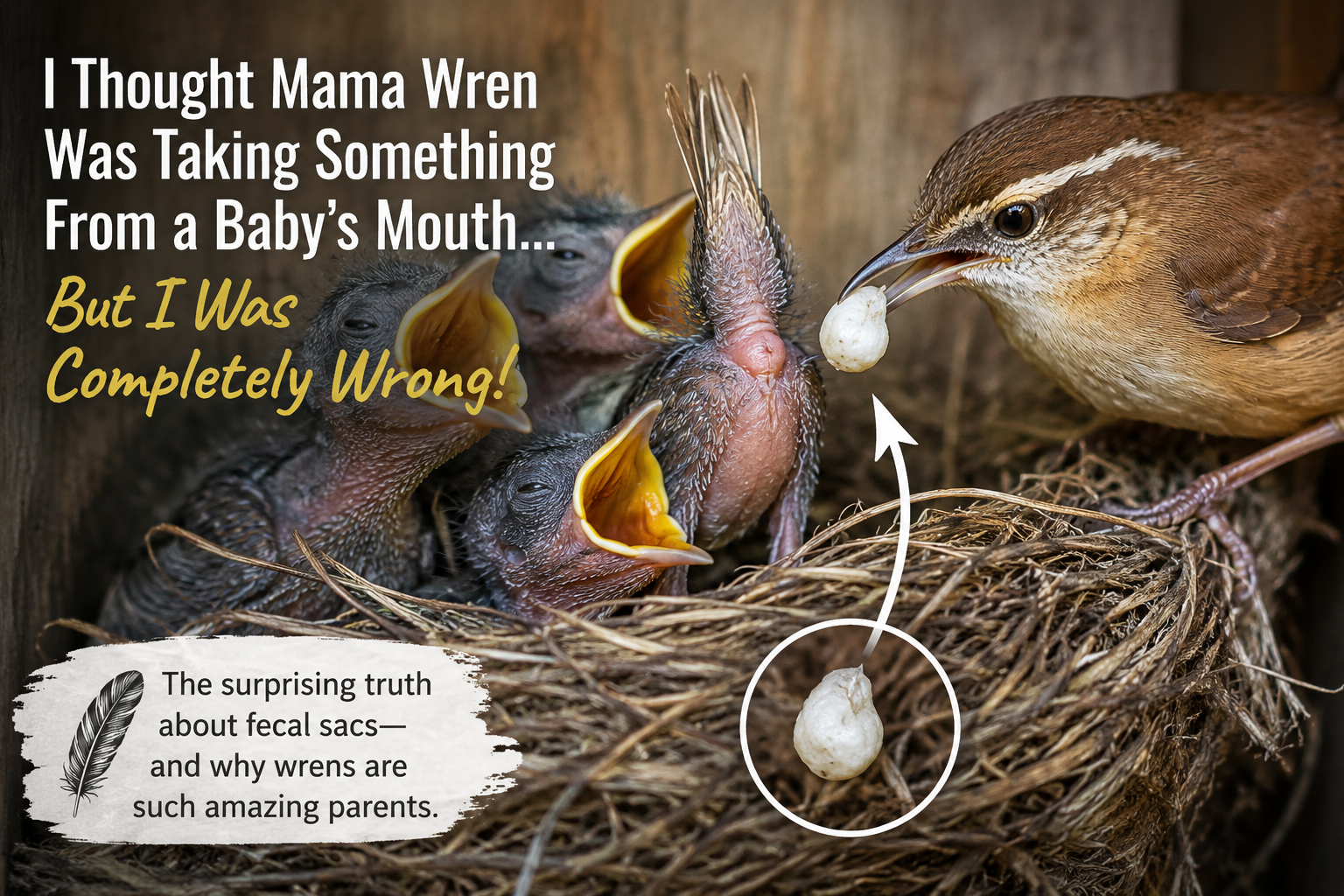
<p class="isSelectedEnd">While reviewing one of the videos, I watched mama wren arrive at the nest carrying food. She leaned over to feed one of her hungry babies, and then something unexpected happened.</p>
<p class="isSelectedEnd">Another chick appeared to "spit out" a small white object, which mama carefully picked up before flying away.</p>
<p class="isSelectedEnd">At first, I was completely confused.</p>
<p class="isSelectedEnd">Was the baby choking? Was she removing something dangerous from its mouth? Had she accidentally dropped part of the insect she had brought for dinner?</p>
<p class="isSelectedEnd">As it turns out... none of those things were happening.</p>
<h2>Meet the Fecal Sac</h2>
<p class="isSelectedEnd">That little white object is called a <strong>fecal sac</strong>.</p>
<p class="isSelectedEnd">Baby songbirds, including Carolina Wrens, don't simply poop into the nest like you might expect. Instead, their droppings are wrapped inside a tough white membrane, creating a neat little package that's easy for the parents to remove.</p>
<p class="isSelectedEnd">Even more amazing, this often happens immediately after a feeding.</p>
<p class="isSelectedEnd">So the sequence I witnessed was actually something like this:</p>
<ul data-spread="false">
<li>Mama arrives with food.</li>
<li>She feeds one hungry chick.</li>
<li>Another chick produces a fecal sac.</li>
<li>Mama immediately picks it up.</li>
<li>She flies away carrying it to dispose of it somewhere far from the nest.</li>
</ul>
<p class="isSelectedEnd">Nature has some incredible housekeeping habits!</p>
<h2>Why Do Wrens Do This?</h2>
<p class="isSelectedEnd">Keeping the nest clean is incredibly important.</p>
<p class="isSelectedEnd">By removing waste, the parents help:</p>
<ul data-spread="false">
<li>Keep bacteria and parasites to a minimum.</li>
<li>Prevent the babies from sitting in their own droppings.</li>
<li>Reduce odors that could attract predators.</li>
<li>Keep the nest healthy while the chicks continue growing.</li>
</ul>
<p class="isSelectedEnd">Considering these tiny birds are raising several hungry babies inside such a small nest, it's remarkable how clean they manage to keep everything.</p>
<h2>Why Is It White?</h2>
<p class="isSelectedEnd">The white color comes from <strong>uric acid</strong>, which is how birds get rid of waste products. Unlike mammals, birds don't produce liquid urine. Instead, the waste is packaged together into that little white sac, making it easy for the parents to carry away.</p>
<h2>Another Lesson From the Wrens</h2>
<p class="isSelectedEnd">One of my favorite parts of this nesting adventure has been discovering behaviors I never knew existed.</p>
<p class="isSelectedEnd">From watching eggs hatch, seeing the babies grow day by day, observing both parents work together to feed their family, and now learning about fecal sacs, I've realized just how much goes on inside a tiny nest that most of us never notice.</p>
<p class="isSelectedEnd">It's a wonderful reminder that nature is full of incredible details hiding in plain sight.</p>
<p>I'm looking forward to seeing what this little wren family teaches me next!</p>
<ul>
<li data-section-id="rt6nlr" data-start="1799" data-end="1819">Carolina Wren nest</li>
<li data-section-id="1n6uguw" data-start="1820" data-end="1841">Baby Carolina Wrens</li>
<li data-section-id="1cobaan" data-start="1842" data-end="1855">Wren chicks</li>
<li data-section-id="tg07oj" data-start="1856" data-end="1872">Backyard birds</li>
<li data-section-id="7g31ud" data-start="1873" data-end="1896">Bird nesting behavior</li>
<li data-section-id="xnbv2h" data-start="1897" data-end="1913">Bird parenting</li>
<li data-section-id="plsafo" data-start="1914" data-end="1925">Fecal sac</li>
<li data-section-id="5uh7bs" data-start="1926" data-end="1943">Nest sanitation</li>
</ul>
            ]]>
        </content>
    </entry>
    <entry>
        <title>Why Didn&#x27;t Mama Carolina Wren Sleep in the Nest Last Night?</title>
        <author>
            <name>Rachy</name>
        </author>
        <link href="https://alabamanaturenotes.com/why-did-mama-wren-leave-the-nest-at-night/"/>
        <id>https://alabamanaturenotes.com/why-did-mama-wren-leave-the-nest-at-night/</id>
        <media:content url="https://alabamanaturenotes.com/media/posts/14/nomamaovernight.png" medium="image" />
            <category term="Nesting Birds"/>
            <category term="Nature Journal"/>
            <category term="Carolina Wren"/>
            <category term="Bird Nest"/>
            <category term="Bird Behavior"/>
            <category term="Backyard Birds"/>
            <category term="Baby Birds"/>
            <category term="Alabama Wildlife"/>
            <category term="2026 Carolina Wren Nest Journal"/>

        <updated>2026-06-26T23:15:02-05:00</updated>
            <summary type="html">
                <![CDATA[
                        <img src="https://alabamanaturenotes.com/media/posts/14/nomamaovernight.png" alt="" />
                    When you've been watching the same family of Carolina Wrens every day&hellip;
                ]]>
            </summary>
        <content type="html">
            <![CDATA[
                    <p><img src="https://alabamanaturenotes.com/media/posts/14/nomamaovernight.png" class="type:primaryImage" alt="" /></p>
                <p class="isSelectedEnd">When you've been watching the same family of Carolina Wrens every day for weeks, you start to notice when something changes.</p>
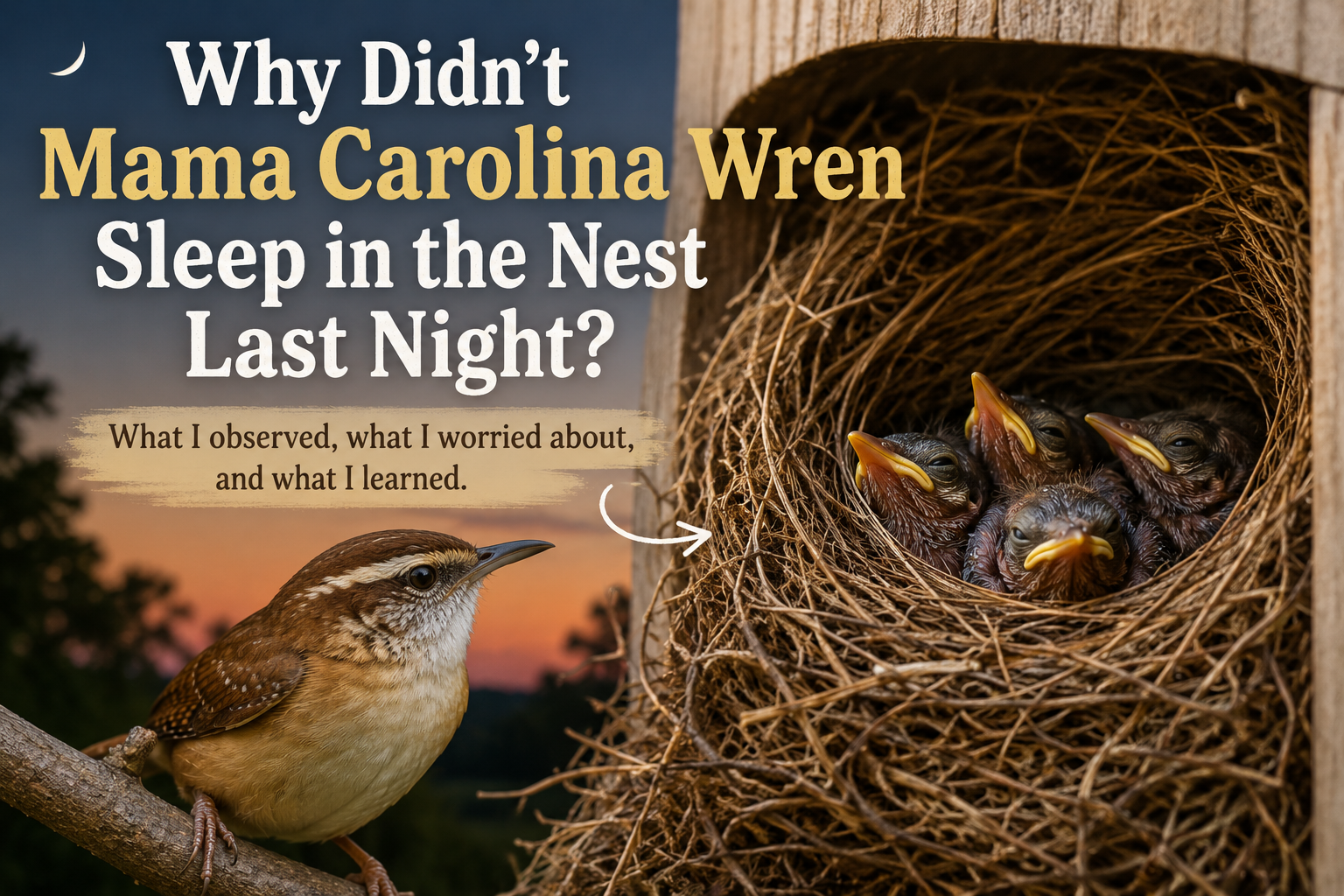
<p class="isSelectedEnd">For the past several nights, mama wren has faithfully returned to the nest around dusk, settling down on top of her four growing chicks until morning. It had become part of our daily routine. As the sun went down, I knew she'd soon be back to keep her babies warm for the night.</p>
<p class="isSelectedEnd">So when she didn't return one evening, I started to worry.</p>
<p class="isSelectedEnd">The last time I saw either parent at the nest was around <strong>7:39 PM</strong>. As the evening became darker, I kept checking the live camera feed, expecting to see her hop back into the nest at any moment.</p>
<p class="isSelectedEnd">She never did.</p>
<p class="isSelectedEnd">An hour passed.</p>
<p class="isSelectedEnd">Then another.</p>
<p class="isSelectedEnd">By around 10:00 PM, I was becoming genuinely concerned. Had something happened to her? Had a predator found her? Were the babies going to be okay without her?</p>
<p class="isSelectedEnd">After spending so much time following this little family, it's hard not to become emotionally invested in them.</p>
<h2>Was Something Wrong?</h2>
<p class="isSelectedEnd">My first thought was that something terrible had happened.</p>
<p class="isSelectedEnd">After all, these chicks were only six days old. They still looked tiny, their feathers were only beginning to develop, and they had spent every previous night tucked safely beneath their mother.</p>
<p class="isSelectedEnd">Without her there, the nest looked strangely empty.</p>
<p class="isSelectedEnd">Rather than assuming the worst, I decided to do a little research.</p>
<h2>It Turns Out This Is Perfectly Normal</h2>
<p class="isSelectedEnd">To my surprise, I learned that female Carolina Wrens don't always continue sleeping in the nest once their chicks become older.</p>
<p class="isSelectedEnd">During the first few days after hatching, the babies aren't able to regulate their own body temperature very well, so mama spends most of the night brooding them to keep them warm.</p>
<p class="isSelectedEnd">As the chicks grow, however, they begin producing more of their own body heat. On warm summer nights, especially here in Alabama, the nest can stay warm enough without mama spending the entire night sitting on them.</p>
<p class="isSelectedEnd">Instead, she may choose to roost on a nearby branch or another sheltered location close to the nest while continuing to keep watch over the area.</p>
<p class="isSelectedEnd">Both parents are still nearby and return at first light to begin another busy day of feeding hungry mouths.</p>
<h2>A Reminder That They're Growing Up</h2>
<p class="isSelectedEnd">Although it gave me quite a scare, seeing mama skip her first night in the nest was actually another milestone in the chicks' development.</p>
<p class="isSelectedEnd">Every day they're becoming a little bigger, a little stronger, and a little more independent.</p>
<p class="isSelectedEnd">It's amazing how quickly things change in just one week.</p>
<p class="isSelectedEnd">Only days ago they were tiny hatchlings with closed eyes, completely dependent on their parents for warmth.</p>
<p class="isSelectedEnd">Now they're eating constantly, growing new feathers every day, and reaching the stage where they no longer need their mother to keep them warm all night long.</p>
<h2>Nature Is Always Teaching Us</h2>
<p class="isSelectedEnd">One of my favourite things about documenting this Carolina Wren family is how often I find myself learning something new.</p>
<p class="isSelectedEnd">At first, I was convinced something had gone wrong.</p>
<p class="isSelectedEnd">Instead, I discovered I'd simply witnessed another normal step in the journey from tiny hatchlings to fledglings.</p>
<p class="isSelectedEnd">Sometimes the things that worry us the most turn out to be perfectly natural.</p>
<p>I'll be keeping a close eye on the nest over the coming days, and I'm looking forward to seeing what new surprises this little wren family has in store next.</p>
            ]]>
        </content>
    </entry>
    <entry>
        <title>Week One With Four Carolina Wren Chicks</title>
        <author>
            <name>Rachy</name>
        </author>
        <link href="https://alabamanaturenotes.com/week-one-with-four-carolina-wren-chicks/"/>
        <id>https://alabamanaturenotes.com/week-one-with-four-carolina-wren-chicks/</id>
        <media:content url="https://alabamanaturenotes.com/media/posts/13/weekonewith4babies.png" medium="image" />
            <category term="2026 Carolina Wren Nest Journal"/>

        <updated>2026-06-21T17:02:09-05:00</updated>
            <summary type="html">
                <![CDATA[
                        <img src="https://alabamanaturenotes.com/media/posts/13/weekonewith4babies.png" alt="" />
                    It's hard to believe that just one week ago these four tiny&hellip;
                ]]>
            </summary>
        <content type="html">
            <![CDATA[
                    <p><img src="https://alabamanaturenotes.com/media/posts/13/weekonewith4babies.png" class="type:primaryImage" alt="" /></p>
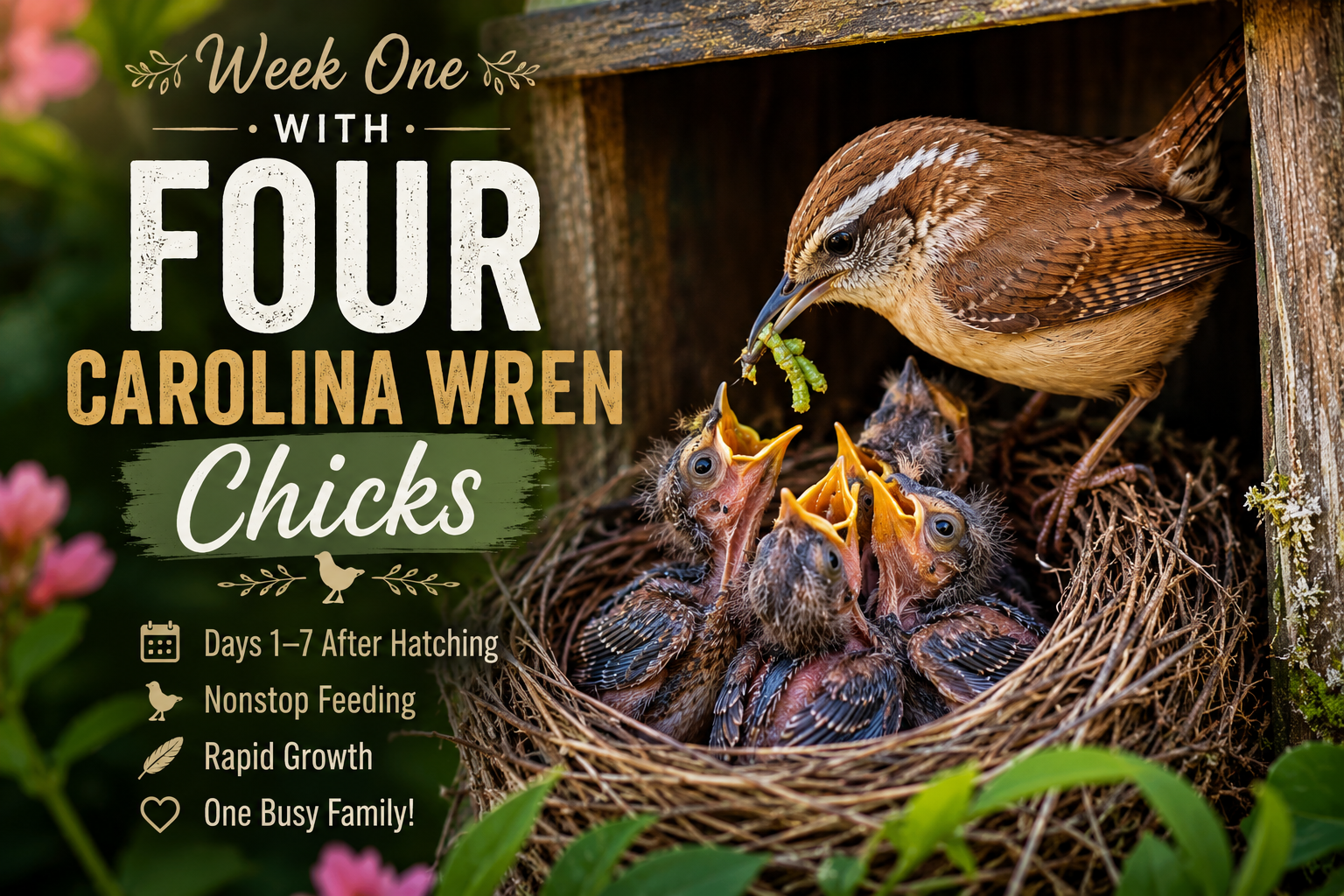
                <p class="isSelectedEnd">It's hard to believe that just one week ago these four tiny Carolina Wren chicks were breaking free from their eggs. Watching them over the past seven days has been fascinating, and every day they've become noticeably bigger and stronger.</p>
<p class="isSelectedEnd">Throughout the week, mama and her companion have been incredibly busy. From sunrise until sunset they're constantly searching for insects, spiders, worms and other food to bring back to the nest. They work as a team, with mama spending most of her time brooding the chicks, keeping them warm, feeding them, and cleaning the nest while her companion frequently delivers food for both her and the babies.</p>
<p class="isSelectedEnd">One thing I've noticed is that the companion rarely enters the nest for long. Most of the time he arrives with food, passes it to mama, then leaves again to continue searching. On a few occasions he returned while mama was away collecting food herself. He appeared unsure of what to do, looking into the nest for a few moments before flying off again without feeding the chicks or sitting on them. He would usually return a few minutes later once mama was back.</p>
<p class="isSelectedEnd">The amount of food these tiny birds eat is incredible. Every few minutes another meal arrives. Spiders, caterpillars, worms and all sorts of insects disappear into four permanently hungry mouths.</p>
<p class="isSelectedEnd">One of the more memorable moments happened when mama tried to feed one chick an enormous worm. It looked far too large for such a tiny baby, and the chick struggled to swallow it. Mama carefully pecked at the worm, seemingly trying to help push it down. Unfortunately the camera stopped recording before I could see how it ended, but thankfully all four chicks continued to do well afterwards.</p>
<p class="isSelectedEnd">The weather certainly didn't make life easy this week. We experienced rain, thunderstorms and some very windy conditions. Despite the changing weather, the parents barely slowed down. Mama stayed with the chicks whenever they needed warmth and protection, only leaving for short periods to collect food before quickly returning to the nest.</p>
<p class="isSelectedEnd">By the end of their first week, the babies had already grown noticeably larger. Their eyes were still closed for much of the week, and one thing that surprised me was just how quiet they were. Unlike many nestlings, I still hadn't heard any peeping from them, even when being fed. Instead, they simply stretched their necks skyward and opened their bright yellow mouths whenever a parent arrived with food.</p>
<p class="isSelectedEnd">On the evening of Day 6, I noticed something that initially worried me. Mama left the nest around 7:39 p.m. and, unlike every previous night, she didn't return to sleep with the chicks. After doing some research, I discovered this can actually be perfectly normal for Carolina Wrens once the chicks are a little older, particularly during warm summer nights. Rather than sleeping in the nest, the female may choose to roost on a nearby branch while both parents continue protecting the area. Although it was unusual to witness after watching her faithfully spend every night with the babies, it appears to be another sign that the chicks are growing up.</p>
<p>Watching this little family has become one of the highlights of my day. Every visit to the nest brings something new to observe, and it's amazing to see how quickly these tiny birds are developing. If their first week is anything to go by, the next few days should be even more exciting as the chicks continue to grow, become more active, and prepare for the day they eventually leave the nest.</p>
<ul>
<li data-section-id="wa7v1d" data-start="4151" data-end="4165">🐣 Chicks: 4</li>
<li data-section-id="fcaaap" data-start="4166" data-end="4194">❤️ All healthy and growing</li>
<li data-section-id="19g3xji" data-start="4195" data-end="4247">🍽️ Meals delivered: Hundreds (too many to count!)</li>
<li data-section-id="1oj4uvx" data-start="4248" data-end="4292">🌧️ Weather: Rain, storms and strong winds</li>
<li data-section-id="m8tnhn" data-start="4293" data-end="4325">🔊 First chirps heard: Not yet</li>
<li data-section-id="1kh6rfw" data-start="4326" data-end="4349">👀 Eyes open: Not yet</li>
<li data-section-id="5su8mr" data-start="4350" data-end="4422">🪶 Biggest surprise: Mama didn't return to the nest overnight on Day 6</li>
</ul>
<p> </p>
            ]]>
        </content>
    </entry>
</feed>